
What Is an rPPG API? Architecture and Use Cases for Developers
An rPPG API lets developers extract heart rate, respiratory rate, and other vital signs from camera video feeds. This guide covers the architecture, endpoints, and real-world use cases.
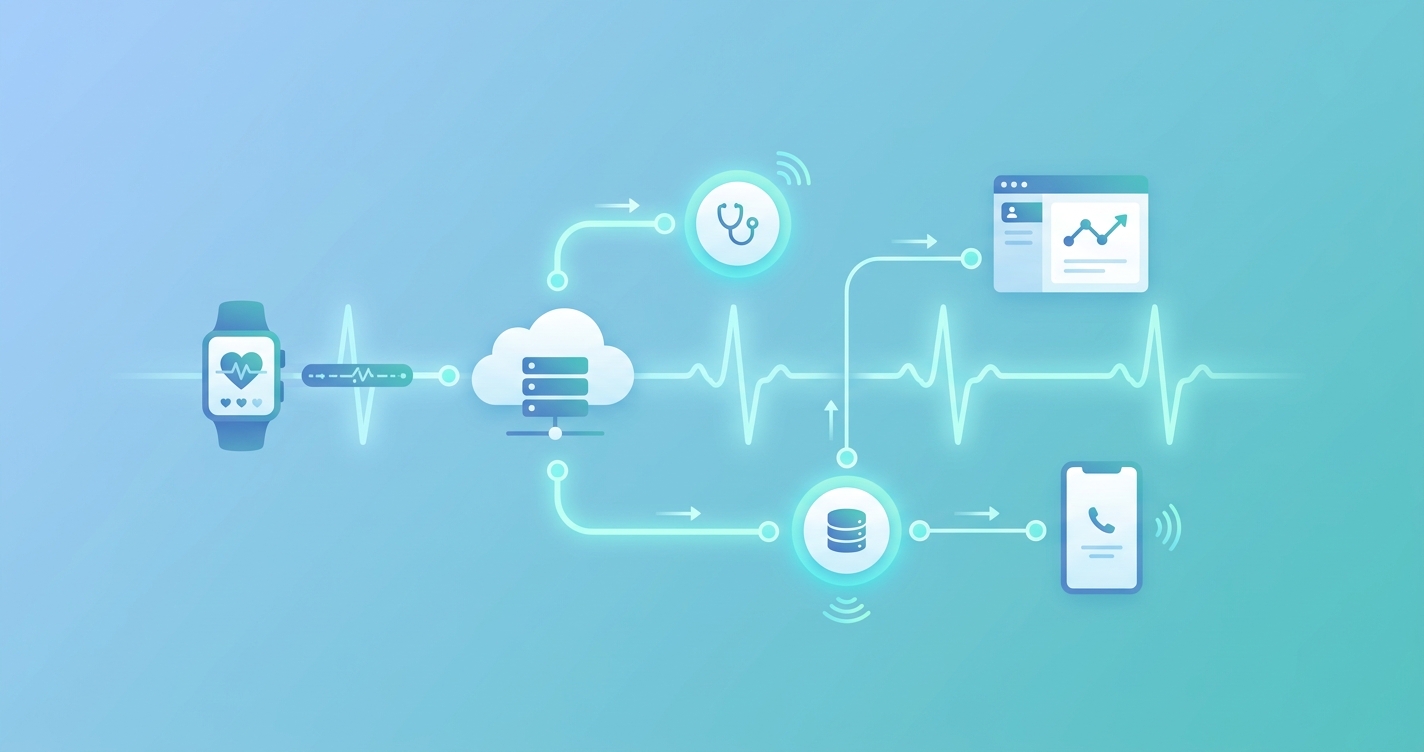
What Is an rPPG API? Architecture and Use Cases for Developers
An rPPG API is a programmatic interface that takes camera video input and returns physiological measurements. Heart rate, respiratory rate, blood oxygen estimation, stress indicators. The underlying technology, remote photoplethysmography, detects sub-pixel color changes in facial skin caused by blood volume fluctuations with each heartbeat. What makes an API layer interesting for developers is that it abstracts away the signal processing, the face detection, the noise filtering, and exposes clean JSON payloads you can actually work with.
"Remote photoplethysmography extracts the blood volume pulse signal by analyzing intensity variations as small as 0.05% to 0.2% of total pixel luminance in facial skin regions." — McDuff et al., ACM Computing Surveys, 2022
The rPPG API architecture developer guide that follows breaks down how these systems are built, what the request-response lifecycle looks like, and where development teams are putting them to use in 2026.
How an rPPG API works under the hood
The pipeline has distinct stages, and understanding them helps when you are debugging integration issues or tuning for specific hardware.
Frame capture and preprocessing is the first stage. The client application captures video frames from a device camera (or receives them from a webcam stream, a kiosk camera, an IP camera feed). Frames get resized and normalized before transmission. Most APIs accept raw frames, short video clips, or real-time WebSocket streams depending on the integration pattern.
Face detection and region of interest extraction happens next. The API isolates the face within the frame and selects skin regions where the rPPG signal is strongest. Forehead, cheeks, and the area below the eyes tend to produce the cleanest signal because they have less muscle movement and good capillary density. A 2025 paper published in Biomedical Engineering Online confirmed that multi-region ROI extraction reduces error rates compared to single-region approaches.
Signal extraction is where the actual physiology gets pulled from pixels. Algorithms like CHROM (chrominance-based) and PBV (blood volume pulse) analyze the normalized color channel data across consecutive frames. The chrominance method, originally proposed by de Haan and Jeanne at Philips Research in 2013, generates the rPPG waveform by calculating ratios of normalized color channels to cancel out motion artifacts and lighting noise.
Post-processing applies bandpass filtering, peak detection, and sometimes Kalman filtering. A 2025 study in PLOS ONE by researchers at the University of Electronic Science and Technology of China demonstrated that combining adaptive Kalman filtering with discrete wavelet transformation improved heart rate measurement accuracy in challenging conditions. The final vital sign values get packaged into structured responses.
Typical API architecture patterns
There are two primary architecture patterns for rPPG APIs, and which one fits depends on your latency requirements and where you want the compute to happen.
| Architecture | Processing location | Latency | Bandwidth needs | Best for |
|---|---|---|---|---|
| Cloud-based REST/WebSocket | Server-side | 200-800ms round trip | High (video upload) | Web apps, telehealth platforms, batch processing |
| On-device SDK with API wrapper | Client-side | 30-100ms | Low (results only) | Mobile apps, kiosks, real-time monitoring |
| Hybrid (on-device extraction, cloud analysis) | Split | 100-300ms | Medium | Enterprise deployments needing both speed and analytics |
Cloud-based APIs follow a straightforward pattern. The client sends video frames or a short clip to an HTTPS endpoint. The server runs face detection, signal extraction, and analysis, then returns a JSON response with the computed vitals. This approach works well when you do not want to ship ML models to the client or when you need centralized logging and analytics.
A typical REST endpoint looks like this in practice:
POST /v1/vitals/analyze
Content-Type: multipart/form-data

Parameters:
- video: binary (5-30 second clip)
- output_format: json
- metrics: ["heart_rate", "respiratory_rate", "spo2", "stress"]
Response:
{
  "session_id": "abc-123",
  "duration_seconds": 15,
  "quality_score": 0.89,
  "vitals": {
    "heart_rate": { "value": 72, "unit": "bpm", "confidence": 0.94 },
    "respiratory_rate": { "value": 16, "unit": "brpm", "confidence": 0.87 },
    "spo2": { "value": 97, "unit": "percent", "confidence": 0.82 },
    "stress_index": { "value": 34, "unit": "score", "confidence": 0.79 }
  },
  "signal_quality": {
    "face_detected": true,
    "motion_level": "low",
    "lighting": "adequate"
  }
}
On-device SDKs process everything locally and expose the same data through local method calls rather than network requests. The advantage is obvious: no video leaves the device, latency drops to milliseconds, and you can run measurements offline. The tradeoff is that you are shipping model weights with your app binary and need to handle device-specific performance tuning.
Hybrid architectures are gaining traction. The device handles face detection and initial signal extraction, sends just the extracted waveform data (not raw video) to the cloud for analysis and trending. This cuts bandwidth by roughly 95% compared to streaming full video frames while keeping the heavy analytics server-side.
Authentication and rate limiting
Most rPPG APIs use API key authentication with optional OAuth 2.0 for user-scoped access. Rate limiting is typically per-key and measured in requests per minute or concurrent sessions, since each vitals measurement session consumes meaningful compute.
| Auth method | When to use it |
|---|---|
| API key (header) | Server-to-server, backend integrations |
| OAuth 2.0 + JWT | User-facing apps where each end user has their own session |
| mTLS | High-security environments, healthcare compliance requirements |
Pagination is not really relevant here because rPPG APIs are not returning collections of records. But session management matters. Most APIs let you create a measurement session, stream frames into it, and then close it to get final computed results. Think of it like a transaction.
Real-world use cases developers are building
Telehealth platforms
The most mature use case. During a video visit, the platform captures the patient's camera feed, runs it through the rPPG API, and surfaces vital signs to the clinician in real time. The patient does not install anything extra and does not need a blood pressure cuff or pulse oximeter. According to Healthcare Digital's 2024 industry report on rPPG, the telehealth segment was the earliest adopter of camera-based vitals APIs because the video feed already exists.
Implementation is relatively simple: intercept the WebRTC video track that is already flowing for the video call, fork a copy to the rPPG processing pipeline, and overlay results in the clinician's interface.
Insurance underwriting
Life insurance carriers are replacing paramedical exams with phone-based vital sign scans. The applicant opens a link, faces their phone camera for 30 seconds, and the rPPG API returns enough biometric data to support accelerated underwriting decisions. This cuts application-to-decision time from weeks to minutes.
The API integration here typically sits behind a white-labeled web view embedded in the carrier's application flow. No app download required.
Corporate wellness programs
Employers are embedding vitals checks into wellness platforms. Employees do a quick camera scan during their health assessment instead of scheduling an onsite biometric screening event. The rPPG API feeds data into the employer's wellness dashboard.
Identity verification and liveness detection
Here the API is not used for health monitoring at all. It detects whether a real, living person is in front of the camera by checking for a genuine blood volume pulse signal. Deepfakes and printed photos do not have blood flow. A 2025 CMU technical report (CMU-CS-25-158) explored the spatiotemporal architecture of rPPG specifically in the context of anti-spoofing and confirmed that pulse signal presence is a reliable liveness indicator.
Driver monitoring systems
Automotive OEMs and fleet management companies use in-cabin cameras to monitor driver fatigue and stress through rPPG. The API runs on edge compute hardware inside the vehicle. Heart rate variability patterns can indicate drowsiness before the driver shows visible signs of fatigue.
Current research and evidence
The research community has been productive. A comprehensive review published in Biomedical Engineering Online in 2025 surveyed deep learning methods for rPPG-based heart rate measurement and reported that most studies achieve root mean square error (RMSE) values below 3 beats per minute compared to contact-based reference devices. That is clinically meaningful accuracy for screening purposes, though the authors noted performance varies with device hardware and ambient lighting.
The reliability question has been studied head-on. A 2025 study published in PMC examined rPPG performance under low illumination and elevated heart rates, two conditions that historically caused problems. The results showed that modern deep learning approaches handle both scenarios better than the earlier algorithmic methods (CHROM, POS, LGI), though accuracy does degrade in very dark environments below 50 lux.
On the signal processing side, the adaptive Kalman filtering approach published in PLOS ONE in 2025 demonstrated meaningful improvements in noisy conditions. The researchers combined Kalman filtering with discrete wavelet transformation to separate the cardiac pulse signal from motion artifacts and environmental noise more reliably than prior filtering approaches.
Rouast Labs, which maintains the VitalLens platform, has published accessible explanations of the underlying rPPG principles. Their technical blog describes the signal chain from raw pixel data through skin segmentation, color space transformation, and temporal filtering to final heart rate output.
Where rPPG APIs are headed
The on-device processing capability is improving fast. Apple's Neural Engine, Qualcomm's Hexagon DSP, and Google's Tensor chips all have enough throughput to run rPPG inference locally on a phone. This shifts the API paradigm. Instead of sending video to a cloud endpoint, the SDK processes locally and the API call becomes a lightweight data submission: "here are the vitals I computed, store them and run population analytics."
WebAssembly is another thread worth watching. Running rPPG inference in the browser via WASM means web applications can measure vitals without any native code, no app install, no SDK integration beyond a JavaScript import. Several open-source rPPG implementations already compile to WASM targets.
Multi-modal measurement is expanding the output surface of these APIs. Rather than just heart rate, newer endpoints return heart rate variability (HRV), blood pressure trends, atrial fibrillation risk scores, and hemoglobin estimation. Each new metric adds integration value for developers building health-oriented products.
Frequently asked questions
How much video does an rPPG API need for accurate results?
Most APIs need 10 to 30 seconds of continuous facial video. Shorter clips increase uncertainty. Some APIs accept streaming input and produce rolling estimates after an initial buffer window of 5 to 8 seconds.
Does lighting affect rPPG API accuracy?
Yes. The signal depends on detecting subtle color changes in skin, so adequate lighting matters. Most APIs include a quality score in their response that indicates whether the input conditions were sufficient. Below approximately 50 lux, accuracy degrades noticeably based on recent research.
Can an rPPG API work through a web browser without an SDK?
It depends on the architecture. Cloud-based APIs that accept video uploads work from any environment that can make HTTPS requests. For real-time browser-based measurement, some vendors offer WebAssembly modules that run inference client-side and communicate results to a cloud API for storage and analytics.
What data privacy considerations apply to rPPG APIs?
Facial video is biometric data in most regulatory frameworks. On-device processing avoids transmitting video entirely. Cloud-based APIs should use TLS in transit, encrypt data at rest, and comply with HIPAA (for US health applications), GDPR, or equivalent regional regulations. Most rPPG API providers offer data processing agreements and can configure zero-retention modes where video is discarded immediately after processing.
Developers building health platforms with contactless vital signs capabilities can explore solutions from companies like Circadify, which offers both SDK and API integration paths for adding camera-based vitals to existing applications. For related reading on this site, see our guides on SDK integration for iOS and Android and building a vitals dashboard with the API.