
How does an rPPG SDK actually work under the hood?
rPPG SDK how it works under the hood: face tracking, ROI selection, signal extraction, filtering, and on-device inference for contactless vitals apps.
How does an rPPG SDK actually work under the hood?
If you search rPPG SDK how it works, you're usually trying to answer a pretty practical question: what exactly happens between a phone camera opening and a heart-rate number showing up on screen? For engineering teams, that answer matters because the hard part is not "using AI" in the abstract. It's whether the pipeline can keep a face locked, reject motion noise, isolate a usable waveform, and return something fast enough to fit inside a real product.
"Remote plethysmographic signals can be measured using ambient light and a simple consumer level digital camera." — Wim Verkruysse, Lars O. Svaasand, and J. Stuart Nelson, Optics Express (2008)
rPPG SDK how it works: the pipeline behind the camera
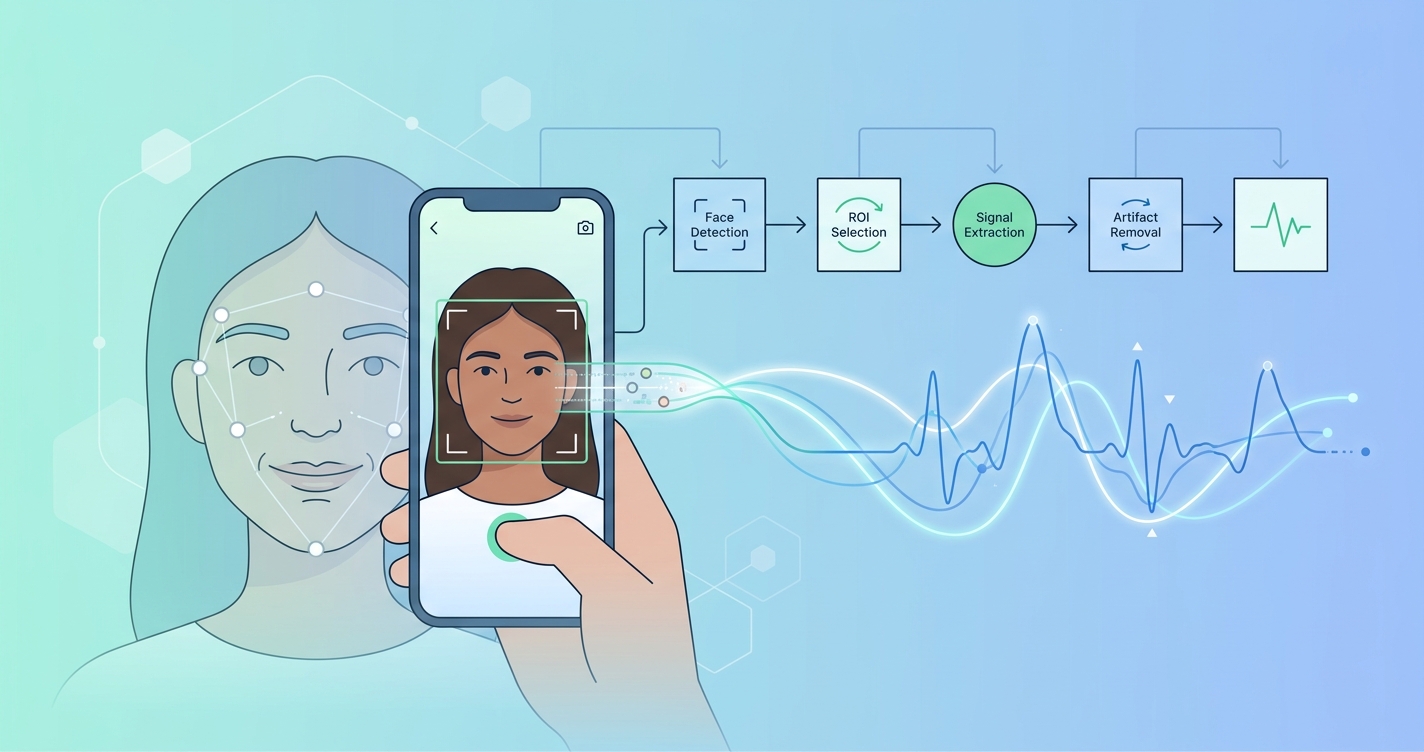
Under the hood, most rPPG SDKs follow the same broad sequence. The camera records short video frames, the SDK finds the face, selects stable skin regions, converts pixel changes into a pulse-like signal, filters away noise, and then estimates physiological outputs from that cleaned signal.
That sounds straightforward until you remember what the model is up against. Skin tone varies. Lighting shifts mid-session. Auto-exposure changes the color balance. Users move. Frame rates drift. The camera itself compresses and denoises in ways the SDK did not ask for. A production SDK is really a stack of defensive systems built around one fragile biological signal.
Here's the simplest way to think about it: the camera sees color, but the SDK is trying to recover rhythm.
What each stage is doing
- Frame capture: the SDK ingests RGB video frames from the front-facing camera
- Face detection and tracking: it identifies the face and keeps landmarks stable from frame to frame
- Region-of-interest selection: it picks areas like the forehead or cheeks where the signal is usually cleaner
- Signal extraction: it turns subtle color fluctuations into time-series data
- Filtering and artifact rejection: it removes noise from motion, lighting shifts, and compression
- Estimation layer: it maps the cleaned waveform to outputs such as pulse or respiratory rate
- Quality gating: it decides whether the reading is usable enough to return at all
That last step gets overlooked in marketing copy, but developers care about it. A good SDK does not just output a number. It also decides when not to trust one.
The comparison developers usually need
| Pipeline Stage | What the SDK does | Why it matters in production | Common failure mode |
|---|---|---|---|
| Frame capture | Samples video at a usable frame rate and exposure | Sets the ceiling for signal quality | Low light, dropped frames |
| Face tracking | Locks onto facial landmarks across frames | Keeps ROIs spatially consistent | Head turns, occlusion |
| ROI selection | Chooses skin patches with strong signal | Improves signal-to-noise ratio | Hair, shadows, reflections |
| Signal extraction | Converts RGB changes into pulse candidates | Creates the actual physiological waveform | Color drift, camera auto-adjustments |
| Filtering | Removes motion and illumination noise | Prevents false peaks | Over-filtering or lag |
| Estimation | Calculates vitals from the waveform | Produces app-level outputs | Weak confidence or unstable readings |
| Quality scoring | Flags low-confidence scans | Protects UX and downstream logic | Returning junk instead of retrying |
Step one is not the model. It's finding a stable face.
A lot of people assume the clever part begins with deep learning. In practice, the first bottleneck is geometry. If the face box jitters or the landmarks drift, the downstream pulse signal gets contaminated before the SDK ever reaches its inference stage.
That is why most production systems start with face detection, then immediately move into landmark tracking. The SDK needs temporal consistency more than a single perfect frame. A good tracker follows the same forehead and cheek regions across dozens or hundreds of frames so the signal processor is comparing like with like.
This is also where product constraints show up. Browser-based flows may get less control over camera parameters than native mobile apps. Low-end Android devices may introduce more rolling-shutter noise. Embedded deployments may have fixed cameras but poor lighting. So when a developer asks how an rPPG SDK works under the hood, the honest answer begins with computer vision housekeeping.
Region-of-interest selection is where weak systems start to fall apart
The next job is choosing where on the face to read. Most SDKs prefer the forehead and cheeks because they often provide larger unobstructed skin areas. But that choice is rarely static.
If glasses cover part of the cheek, the SDK may down-rank that patch. If the user tilts toward a window, one side of the face may become overexposed. If a beard or makeup changes the texture distribution, the algorithm may shift weighting toward other regions. Better systems score multiple candidate regions and combine them instead of betting everything on one patch.
This part traces back to the early literature. Verkruysse and colleagues showed in 2008 that ambient-light video can reveal plethysmographic information remotely. Later work focused less on proving the idea existed and more on figuring out how to recover that signal reliably when the face, camera, and room are all imperfect.
Signal extraction: turning RGB values into a pulse waveform
Once the SDK has stable facial regions, it starts measuring tiny changes in pixel intensity over time. Those changes are influenced by blood volume shifts under the skin, but they are also influenced by almost everything else in the scene. So the extraction method matters a lot.
Gerard de Haan and Vincent Jeanne's 2013 paper in IEEE Transactions on Biomedical Engineering became one of the field's key references because it improved robustness with a chrominance-based approach. According to the paper, the method reached 92% agreement with contact PPG for stationary subjects and improved pulse-rate accuracy under modest motion from 79% to 98%.
A few years later, Wenjin Wang, Sander Stuijk, and Gerard de Haan pushed the theory further with the POS method in their 2017 paper, Algorithmic Principles of Remote PPG. Their contribution was important for SDK builders because it gave a cleaner mathematical explanation for why skin-tone-linked color subspaces can help separate physiological rhythm from nuisance variation.
In plain English: modern SDKs do not just average green pixels and hope for the best. They transform the color data into spaces that make the pulse easier to isolate and lighting noise easier to suppress.
Filtering is where a research demo becomes a real SDK
A lab prototype can work with a cooperative participant under steady lighting. A production SDK has to survive kitchen lights, laptop webcam compression, a user talking during capture, and someone checking Slack in the middle of the scan.
So filtering layers do a lot of the real work. Some are classical signal-processing steps: detrending, temporal normalization, band-pass filtering, peak validation, and outlier rejection. Some are learned models trained to distinguish pulse-consistent patterns from motion artifacts. Usually it is both.
That hybrid approach shows up in recent reviews too. A 2025 Frontiers review on deep learning and remote photoplethysmography described the field as moving toward pipelines that mix optics-aware preprocessing with neural methods rather than replacing one with the other outright. That matches what most SDK teams actually ship: a layered system, not a single magic model.
The estimation layer is increasingly lightweight
One reason this category is moving faster now is that the model budgets are getting smaller. The 2025 ME-rPPG paper, Memory-efficient Low-latency Remote Photoplethysmography through Temporal-Spatial State Space Duality, reported real-time inference with 3.6 MB of memory and 9.46 ms latency while improving cross-dataset mean absolute errors by 21.3% to 60.2% versus baselines on MMPD, VitalVideo, and PURE.
For developers, that number matters more than yet another abstract accuracy chart. A few years ago, teams often assumed camera-based vitals would need cloud GPUs or heavyweight mobile inference. Now the constraint is less about raw compute and more about packaging the entire pipeline cleanly: camera access, frame scheduling, on-device processing, result quality flags, and app-level APIs.
That is also why architecture choices around on-device vs cloud processing for vitals SDKs matter so much. The signal model may fit on-device now, but the surrounding SDK still has to be engineered for battery, latency, and privacy trade-offs.
Industry applications
Mobile health apps
In consumer and digital health apps, the SDK usually has to do everything locally and quickly. Startup teams do not want a fragile measurement flow that depends on perfect connectivity. Under-the-hood efficiency matters because it determines whether the feature feels instant or awkward.
Telehealth and virtual care platforms
Telehealth teams care about browser compatibility, predictable latency, and graceful degradation when the camera feed is messy. Here, a robust tracking and quality-gating layer often matters more than chasing one more decimal point in a benchmark.
White-label and enterprise SDK deployments
For CTOs and VP Engineering teams, the real question is maintainability. Can the SDK expose clear callbacks, confidence scores, retry states, and analytics hooks? Can it be dropped into iOS, Android, or web stacks without forcing a rewrite? Posts like rPPG SDK iOS and Android integration matter because the interface around the core signal model is usually where delivery timelines get won or lost.
Current research and evidence
The literature has moved in a fairly consistent direction. Verkruysse, Svaasand, and Nelson (2008) established that ambient-light video from a consumer camera could recover plethysmographic signals remotely. De Haan and Jeanne (2013) improved motion robustness through chrominance modeling. Wang, den Brinker, Stuijk, and de Haan (2017) formalized the POS framework and helped clarify the algorithmic principles behind color-space pulse extraction.
More recently, Daniel McDuff and co-authors helped standardize evaluation with the NeurIPS 2023 rPPG-Toolbox, which bundled benchmark datasets, preprocessing pipelines, and comparable evaluation logic. That matters for SDK buyers because reproducibility is still a problem in this category. A demo can look excellent without telling you much about how it will behave across devices, resolutions, lighting conditions, and user behavior.
The broad pattern is encouraging for builders: the field is no longer stuck proving that rPPG exists. It is busy refining how to make it robust, fast, and reproducible enough for software teams to ship.
The future of rPPG SDK architecture
The next wave will probably look less like one giant model and more like better orchestration. Expect stronger multi-region weighting, cleaner quality estimation, smaller on-device inference footprints, and more browser-native deployment paths.
I also think developers will care more about observability than the category did a year ago. Under the hood is not just signal extraction anymore. It is session diagnostics, confidence scoring, fallback behavior, and integration ergonomics. The teams that win here will make the pipeline inspectable, not just impressive in a slide deck.
Frequently asked questions
Does an rPPG SDK use raw video or individual image snapshots?
Usually raw video frames or a short frame sequence. The pulse signal depends on change over time, so a single image is not enough. The SDK needs temporal data to recover a waveform.
Why do most rPPG SDKs focus on the forehead and cheeks?
Those regions often provide broader, cleaner skin patches with fewer sharp edges than areas near the mouth or eyes. They also tend to be easier to track consistently across frames.
Is the green channel still the main signal source?
Often yes, but modern systems rarely rely on the green channel alone. The early ambient-light work by Verkruysse and colleagues found the green channel especially informative, while later methods such as CHROM and POS use transformed color combinations to improve robustness.
What makes a production SDK different from an academic demo?
Usually everything around the core paper: camera handling, device adaptation, motion rejection, quality scoring, API design, and predictable behavior across real-world edge cases.
If your team is evaluating how to package this pipeline into a product, Circadify is building SDK workflows for contactless vitals and custom integration paths for health platforms. You can explore the developer route here: Developer docs + API keys → circadify.com/custom-builds.