
On-Device vs Cloud Processing for Vitals SDKs: 2026 Comparison
On-device vs cloud processing for vitals SDKs compared — latency, privacy, cost, and architecture trade-offs developers face when building camera-based health features in 2026.
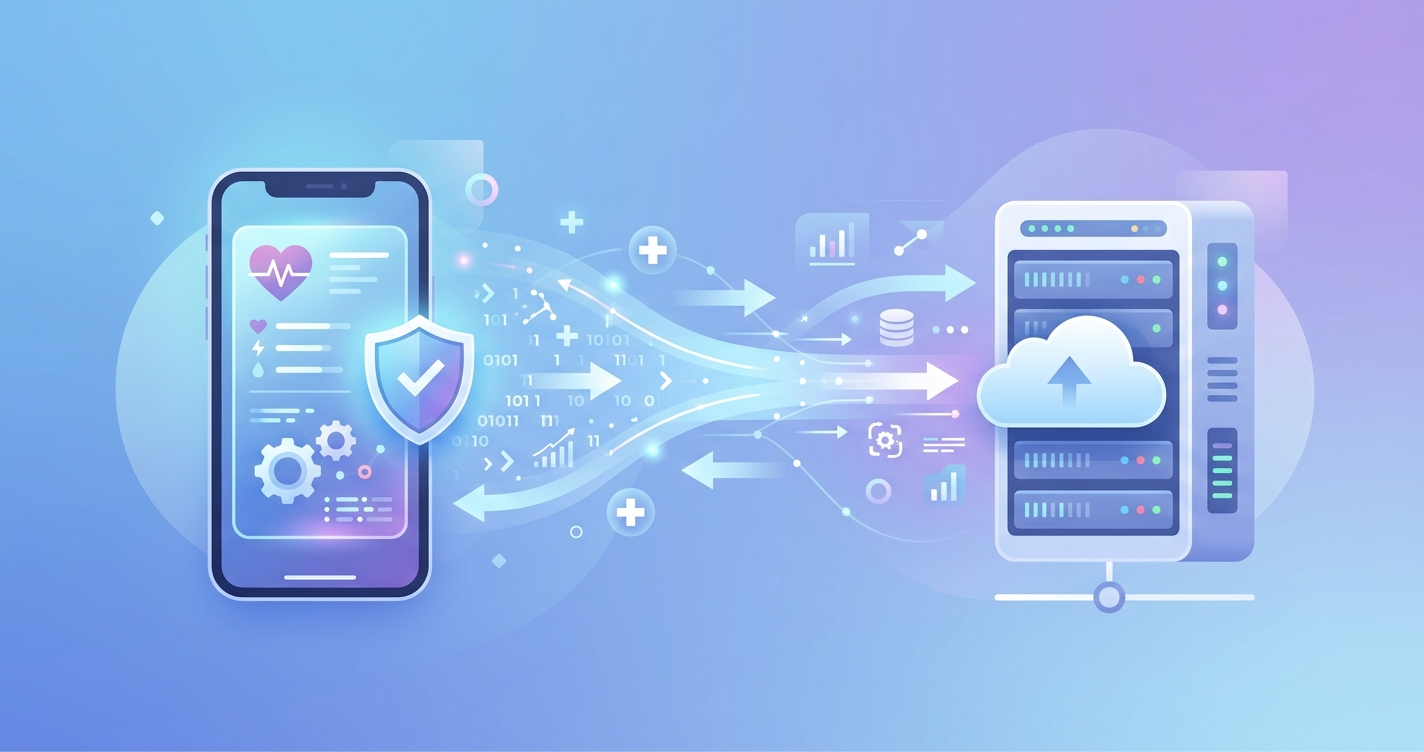
On-device vs cloud processing for vitals SDKs: 2026 comparison
Every team building camera-based vitals into their product hits this fork in the road. Do you run the rPPG model on the user's phone, or ship video frames to a server and process them in the cloud? The on-device vs cloud vitals SDK decision shapes everything downstream — your latency budget, your privacy posture, your infrastructure costs, and how many phones your app actually works on.
There's no universally right answer. But after watching how the industry has moved over the past two years, some patterns are pretty clear.
"With only 580K parameters, ME-rPPG uses 3.6 MB of memory and has a latency of 9.46 ms, making real-time rPPG prediction feasible on mobile devices." — Chen et al., arXiv, April 2025
What "on-device" actually means for vitals processing
On-device processing means the entire pipeline — face detection, region-of-interest extraction, signal processing, and vital sign estimation — runs locally on the user's hardware. No video frames leave the phone. No network round-trip happens. The SDK loads a model into memory, feeds it camera frames, and outputs heart rate, respiratory rate, and other measurements directly.
This became practical for rPPG around 2023-2024 when model architectures got small enough. The ME-rPPG model published by researchers at the University of Oulu in April 2025 demonstrated that a state-space model with 580,000 parameters could predict pulse waveforms in 9.46 milliseconds on a mobile device, using just 3.6 MB of memory. That's small enough to run on phones from 2019.
Earlier architectures like EfficientPhys and LightweightPhys from the Idiap Research Institute had already pushed rPPG models below 1 million parameters, but ME-rPPG was notable for achieving real-time waveform prediction (not just post-hoc batch analysis) during the recording itself. The user doesn't wait for a scan to finish before getting readings.
The practical upshot: if you're integrating a vitals SDK in 2026, on-device inference isn't a compromise anymore. "Runs on the phone" stopped meaning "runs worse" about a year ago.
What cloud processing looks like in practice
Cloud-based vitals processing typically works one of two ways. Either the SDK captures a short video clip and uploads it to a server for batch analysis, or it streams extracted signal data (not raw video) to a cloud endpoint that runs a heavier model.
The first approach — upload and analyze — adds 2-8 seconds of latency depending on video length, network speed, and server load. The second approach can get latency down to 50-200 milliseconds per reading if you're streaming preprocessed signals rather than raw frames.
Cloud processing made more sense in 2022-2023, when the best-performing rPPG models were too large or too computationally expensive for mobile hardware. Transformer-based architectures like PhysFormer required GPU-class compute. Running them on a phone wasn't realistic.
By 2026, the situation has changed. Mobile neural processing units (NPUs) on chips like the Apple A17 Pro, Snapdragon 8 Gen 3, and Google Tensor G4 can handle the inference workloads that required cloud GPUs three years ago. A benchmark study from USC's QED Lab found that modern mobile devices achieve inference latencies under 10 milliseconds for models in the 1-5 million parameter range — well within what rPPG models require.
The comparison that matters
The abstract debate doesn't help much. Here's how on-device and cloud processing compare across the dimensions that actually affect your product:
| Factor | On-Device Processing | Cloud Processing |
|---|---|---|
| Inference latency | 5-15 ms | 50-8000 ms (depends on architecture) |
| Network dependency | None after SDK download | Required for every measurement |
| Works offline | Yes | No |
| Raw data leaves device | No | Depends on implementation |
| Model size constraint | Limited by device memory (typically < 50 MB) | No practical limit |
| Compute cost per scan | Zero (runs on user hardware) | $0.001-0.01 per scan at scale |
| Device compatibility floor | Needs NPU or sufficient CPU | Any device with a camera and internet |
| Model update mechanism | SDK update (app store review) | Server-side, instant |
| Maximum model complexity | Constrained by mobile silicon | Unconstrained |
| Battery impact per scan | Moderate (30-60 seconds of CPU/NPU) | Low device-side, but radio usage |
Some of these trade-offs are obvious. Others aren't.
Privacy and compliance: where on-device wins outright
This is the one area where the comparison isn't close. When you process vitals on-device, biometric data never touches your servers. You can't leak what you never collected.
For health platforms operating under HIPAA, GDPR, or similar frameworks, on-device processing eliminates entire categories of compliance work. You don't need a Business Associate Agreement for vitals processing if processing happens on the user's phone. You don't need to encrypt biometric data in transit if it never transits. You don't need data residency controls if the data stays on the device that created it.
The algo.com's 2025 analysis of edge computing in regulated industries noted that on-device architectures "can satisfy HIPAA PHI residency requirements while enabling sub-10ms clinical decision support." The Kiosk Industry Group went further, arguing that for patient-facing health kiosks, "edge inference should be the default architectural standard" because cloud-based AI creates unnecessary HIPAA liability.
This matters more now than it did even two years ago. The EU's AI Act classifies health-related AI systems as high-risk, which adds documentation and audit requirements for any system processing biometric health data. If that data never leaves the device, you've just cut your compliance surface in half.
Cost at scale: the math gets obvious fast
Here's where on-device processing wins in a way that compounds. If you process vitals in the cloud, every scan costs you compute time. A lightweight inference call might cost $0.001, but at 100,000 daily active users taking two scans each, that's $200 per day, $6,000 per month, $73,000 per year — and that's before you account for video storage, bandwidth, or the engineering time to maintain a GPU inference cluster.
On-device processing costs you nothing per scan. The compute happens on hardware the user already owns. Your cost is the engineering effort to optimize the SDK and the initial model training, both of which are fixed costs that don't scale with usage.
A health platform running 10 million scans per month would spend roughly $10,000-100,000 monthly on cloud inference (depending on model size and GPU pricing). That same platform running on-device processing spends zero on per-scan compute.
The break-even point comes fast. For most teams, on-device processing is cheaper by the time you hit a few thousand daily users.
When cloud processing still makes sense
On-device isn't always the right choice. There are real scenarios where cloud processing earns its complexity:
Ensemble models and multi-modal analysis
If your product needs to combine rPPG signals with other data sources — voice biomarkers, motion analysis, environmental context — running a large fusion model in the cloud might produce better results than constraining everything to fit on a phone. Some clinical-grade applications use ensemble approaches where multiple models vote on a final reading. That's hard to do within mobile memory and power budgets.
Legacy device support
Not every phone has a neural processing unit. If your user base includes a significant number of devices from 2018 or earlier, cloud processing gives you consistent results across hardware. The model runs on your GPU, so the user's phone specs don't matter beyond having a working camera.
Rapid model iteration
Cloud-hosted models update instantly. You push a new model to your servers, and every user gets the improved version on their next scan. On-device models require an SDK update, which means an app store submission, a review cycle, and gradual user adoption. If you're iterating on model accuracy weekly, the cloud update path is significantly faster.
Research and training data collection
If users consent to share their video data for model improvement (and your privacy framework supports it), cloud processing gives you access to real-world training data. On-device processing, by design, makes this harder. You'd need an explicit data contribution flow separate from the vitals measurement itself.
The hybrid pattern most teams land on
In practice, the majority of production vitals SDKs in 2026 use a hybrid architecture. Primary inference runs on-device for speed and privacy. Aggregated, anonymized results (not raw data) sync to the cloud for longitudinal tracking, population health analytics, and model performance monitoring.
This pattern gives you the latency and privacy benefits of on-device processing with the analytical capabilities of cloud infrastructure. The user gets instant results. Your data science team gets aggregate statistics. The raw biometric signal stays on the phone.
Spheron Network's 2026 guide on hybrid cloud-edge inference described this as the convergence point: "Edge devices handle real-time processing and immediate decisions, while the cloud manages large-scale analytics, storage, and long-term processing." The same logic applies directly to vitals SDKs.
How the hybrid architecture works in practice
- SDK captures and processes locally — the rPPG model runs on-device, producing vital sign readings in real time
- Results (not raw data) transmit to the server — heart rate value, confidence score, and session metadata go to your backend. No video frames, no biometric signals.
- Cloud handles analytics and storage — longitudinal trends, population baselines, anomaly detection across user cohorts
- Model updates deploy via SDK releases — new model weights ship with app updates; the cloud doesn't serve inference
This separation keeps the latency-sensitive and privacy-sensitive work local while letting the cloud do what it's actually good at: crunching large datasets and storing history.
What this means for SDK selection in 2026
If you're evaluating vitals SDKs for integration, the processing architecture should be near the top of your criteria list. Here's what to look for:
- On-device inference as default — the SDK should process locally without requiring a network connection during measurement
- Transparent model architecture — you should know the model size, parameter count, and minimum hardware requirements
- Privacy by design — raw video and biometric signals should never leave the device unless the user explicitly opts in
- Offline capability — the core measurement should work without internet access
- Hybrid data sync — aggregated results should be syncable to your backend via documented APIs
The rPPG models available today are small enough, fast enough, and accurate enough that there's no real performance penalty for running on-device. The privacy and cost advantages compound over time. Cloud-only vitals processing is starting to look like a legacy architecture — it made sense when models were too heavy for phones, but that constraint mostly disappeared around 2024.
Circadify's SDK is built around on-device inference, processing vitals locally on the user's phone without transmitting video data to external servers. For teams evaluating how to add contactless vitals to their platform, the developer documentation and API reference covers the integration workflow.
Frequently asked questions
Does on-device processing produce less accurate results than cloud processing?
Not in 2026. The gap that existed in 2022-2023 — when larger cloud models outperformed mobile-optimized ones — has largely closed. Research from the University of Oulu showed that compact models with under 1 million parameters achieve comparable accuracy to their larger counterparts on standard rPPG benchmarks. The constraint is now model architecture quality, not compute budget.
What's the minimum phone hardware needed for on-device vitals SDK processing?
Most production SDKs target phones from 2020 or later. Devices with Apple's A14 chip, Qualcomm Snapdragon 7-series, or equivalent processors handle real-time rPPG inference without noticeable lag. Some optimized models (like ME-rPPG at 3.6 MB) can run on older devices, but SDK vendors typically set a floor around 4 GB RAM and a 2020-era processor for consistent performance.
How does on-device processing affect battery life?
A 30-second vitals scan using on-device inference consumes roughly the same battery as 30 seconds of active camera use (since the camera is the primary power draw regardless of where processing happens). The neural network inference adds a small incremental load — typically 5-15% more power draw than camera-only operation. Cloud processing offloads the compute but requires active radio transmission, which has its own battery cost. In practice, the difference between on-device and cloud battery consumption per scan is negligible.
Can I switch from cloud to on-device processing later without rebuilding my integration?
It depends on the SDK. Some vitals SDKs abstract the processing location behind a consistent API — you call the same methods regardless of whether inference runs locally or in the cloud. Others have tightly coupled architectures where switching processing modes requires significant rework. When evaluating SDKs, ask specifically about processing mode flexibility and whether the API contract changes between on-device and cloud configurations.