Why does that wellness app want to scan my face for vitals?
Dive into the science of camera-based vital sign monitoring (rPPG). Understand why a face scan app measures vitals and the technical challenges that lead teams to license an SDK.
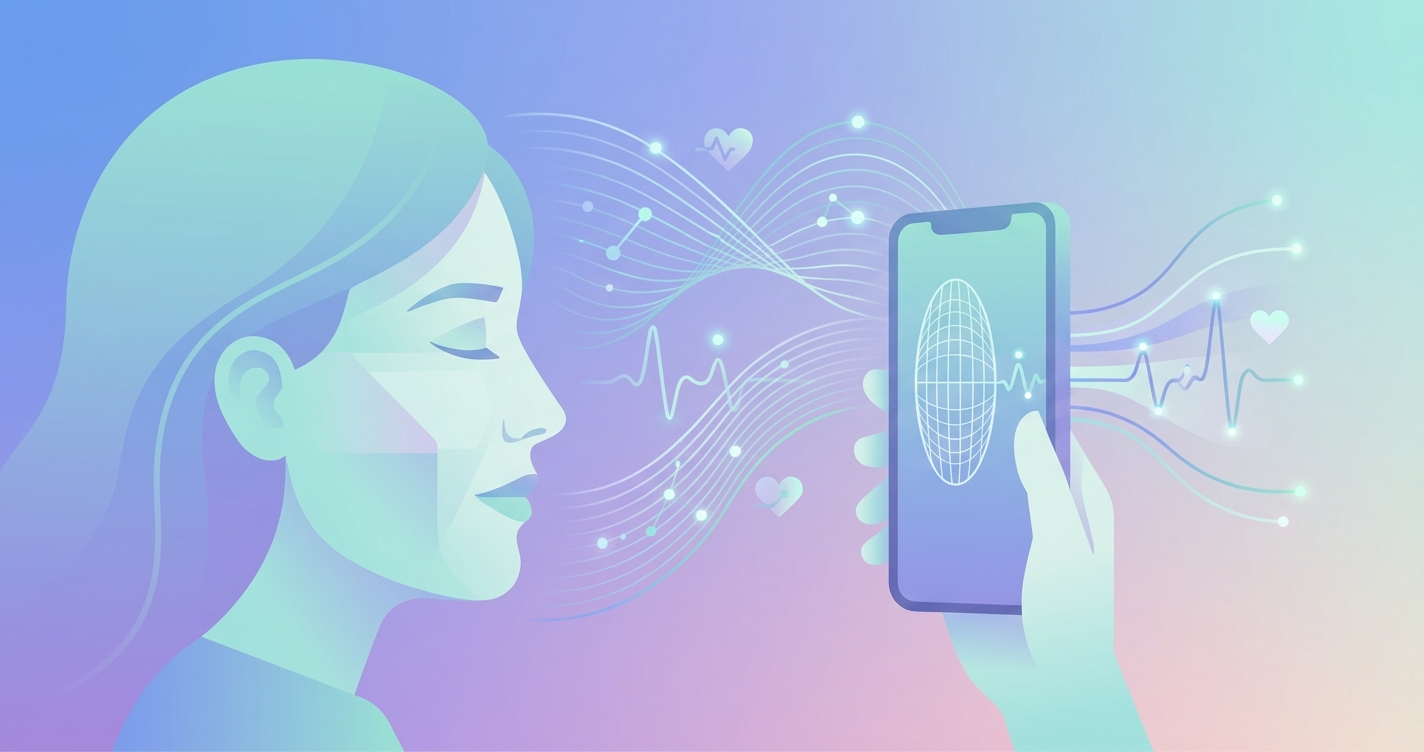
You opened a new wellness app, followed the onboarding steps, and then it happened: the app asked for permission to use your camera to scan your face and measure your vital signs. It's a surprising feature, blending science fiction with your daily health routine. This technology, which seems futuristic, is grounded in a well-understood optical technique called remote photoplethysmography (rPPG), and it's rapidly moving from the lab to mainstream applications. For engineering leaders, the rise of camera-based vitals presents a significant product opportunity, but it also comes with a critical build-versus-buy decision.
"The principle is based on the fact that human skin is translucent. Light that penetrates the skin is partially absorbed by blood, and the amount of absorption depends on the blood volume, which changes with the heart's pumping action." - Dr. Wim Verkruysse, Optics Express (2008)
How a face scan app measures vitals using light
At its core, a face scan app measures vitals by detecting subtle, invisible-to-the-eye changes in the color of your skin. This process relies on remote photoplethysmography. Here's a breakdown of how it works:
- Light and Blood: Your smartphone camera emits light (or uses ambient light). When this light hits your face, it penetrates the outer layers of skin.
- Hemoglobin Absorption: The hemoglobin in your blood absorbs a specific amount of light. As your heart beats, it pumps blood through the vessels in your face, causing the volume of blood to increase and decrease cyclically.
- Color Signal: This fluctuation in blood volume causes a corresponding fluctuation in how much light is absorbed. The camera's sensor is sensitive enough to pick up these tiny changes in the reflected light, which manifest as a color signal. The green light channel is particularly effective for this, as hemoglobin has a high absorption coefficient in that part of the spectrum.
- Signal Processing: This is where the real complexity lies. The raw video feed is noisy. Advanced signal processing algorithms are required to isolate the tiny, periodic blood flow signal from noise caused by subject movement, changes in lighting, and compression artifacts from the camera sensor itself.
- Calculating Vitals: Once a clean pulsatile signal is extracted, the algorithm can calculate the time between peaks to determine Heart Rate (HR). Further analysis of the signal's waveform can yield Heart Rate Variability (HRV), and by analyzing frequency components, some systems can also estimate Respiratory Rate.
This technique was first demonstrated in a foundational paper by Wim Verkruysse and his colleagues at the Beckman Laser Institute in 2008, who proved that a simple digital camera and ambient light were sufficient to measure physiological signals remotely.
Build in-house vs. license commercial sdk: a comparison for engineering teams
The decision to integrate camera-based vitals isn't just about the science; it's about the engineering reality. While the concept is straightforward, the implementation is fraught with challenges. This is why many teams opt to license a commercial Software Development Kit (SDK) rather than building from scratch.
| Factor | Build In-House | License Commercial SDK |
|---|---|---|
| Time to Market | 12-24+ months | 1-4 weeks |
| Upfront Cost | High (Salaries for AI/ML engineers, data scientists, clinical researchers) | Low to Medium (Licensing fees) |
| Ongoing Maintenance | High (Algorithm updates, model retraining, OS compatibility) | Included in license |
| Required Expertise | Signal processing, computer vision, machine learning, clinical validation | Mobile/web development |
| Data & Compliance | Requires sourcing and managing massive, diverse datasets; significant compliance burden | Managed by SDK vendor; often includes privacy-by-design architecture |
| Accuracy & Robustness | Years of R&D to match market leaders, especially across different skin tones, lighting, and motion | uses vendor's aggregated R&D across millions of scans |
Industry Applications
The ability to measure vitals with a camera is not just a novelty; it's enabling new models of care and engagement across several industries.
Telehealth and remote patient monitoring
For telehealth platforms, rPPG offers a way to gather objective data during virtual consultations. A doctor can get a baseline heart rate or respiratory rate from the patient's video feed, adding a crucial data point that was previously missing from remote care.
Wellness and fitness tracking
Consumer wellness apps use rPPG to help users track their heart rate before and after a meditation session, a workout, or to monitor their stress levels throughout the day without requiring a wearable device.
Insurtech and digital underwriting
Life and health insurance companies are exploring rPPG for digital underwriting and risk assessment. A potential policyholder could complete a health screening from their own phone, streamlining a process that traditionally requires in-person medical exams.
Current research and evidence
While early research like Verkruysse's 2008 paper established the proof of concept, modern research focuses on making rPPG robust enough for real-world applications. A 2023 study published in Scientific Reports confirmed that while rPPG shows high correlation with standard ECG and contact PPG devices for heart rate, accuracy can be impacted by motion artifacts and head movement.
Another significant challenge is ensuring performance across diverse populations. Research has shown that algorithmic bias is a real risk, with many early models performing poorly on darker skin tones due to differences in light absorption. Addressing this requires training models on vast, diverse datasets, a resource-intensive process that is a major focus for commercial SDK providers.
The future of contactless vitals monitoring
The technology is advancing rapidly. The next frontier for rPPG includes expanding the range of biomarkers that can be measured. Active research is underway to develop reliable, camera-based methods for measuring:
- Blood Pressure
- Blood Oxygen Saturation (SpO2)
- Blood Glucose Levels
- Blood Alcohol Content
As smartphone camera sensors improve and signal processing algorithms become more sophisticated, the accuracy and reliability of these measurements will continue to increase, unlocking even more use cases. The trend is moving toward on-device processing to enhance user privacy and reduce server-side computational loads.
Frequently asked questions
Q: Is a face scan for vitals actually accurate?
A: For heart rate, the accuracy of leading rPPG systems can be very high, often within a few beats per minute of a medical-grade contact device under good conditions (stable lighting, minimal motion). Accuracy for other vitals like respiratory rate and HRV is an active area of development.
Q: What vital signs can be measured from a face scan?
A: The most common and reliable vital sign measured is heart rate. Many systems also provide heart rate variability (HRV) and respiratory rate. Experimental systems are working on blood pressure and blood oxygen saturation, but these are not yet widely available or validated for general use.
Q: Is my data safe when an app scans my face for vitals?
A: This depends on the app's architecture. Reputable SDKs and platforms process the video stream on-device, meaning the video of your face never leaves your phone. Only the final, anonymized vital sign data is sent to the app's servers. As an engineering leader, this is a critical question to ask any potential SDK vendor.
The emergence of the face scan app that measures vitals is a clear indicator of a major shift in digital health. It represents a move towards more accessible, lower-friction data collection that can empower users and providers alike. For technology leaders, the path forward isn't about reinventing the wheel. Circadify is addressing this space by providing developer teams with a robust, reliable, and privacy-centric rPPG SDK that can be integrated in a matter of days, not years. If you're considering adding contactless vitals to your platform, explore our developer documentation and request an API key to see how you can accelerate your roadmap.