
Vitals SDK Data Residency: Meeting EU and US Rules
An engineering guide detailing how data residency, on-device processing, and regional storage choices affect contactless vitals deployments in the EU and US.
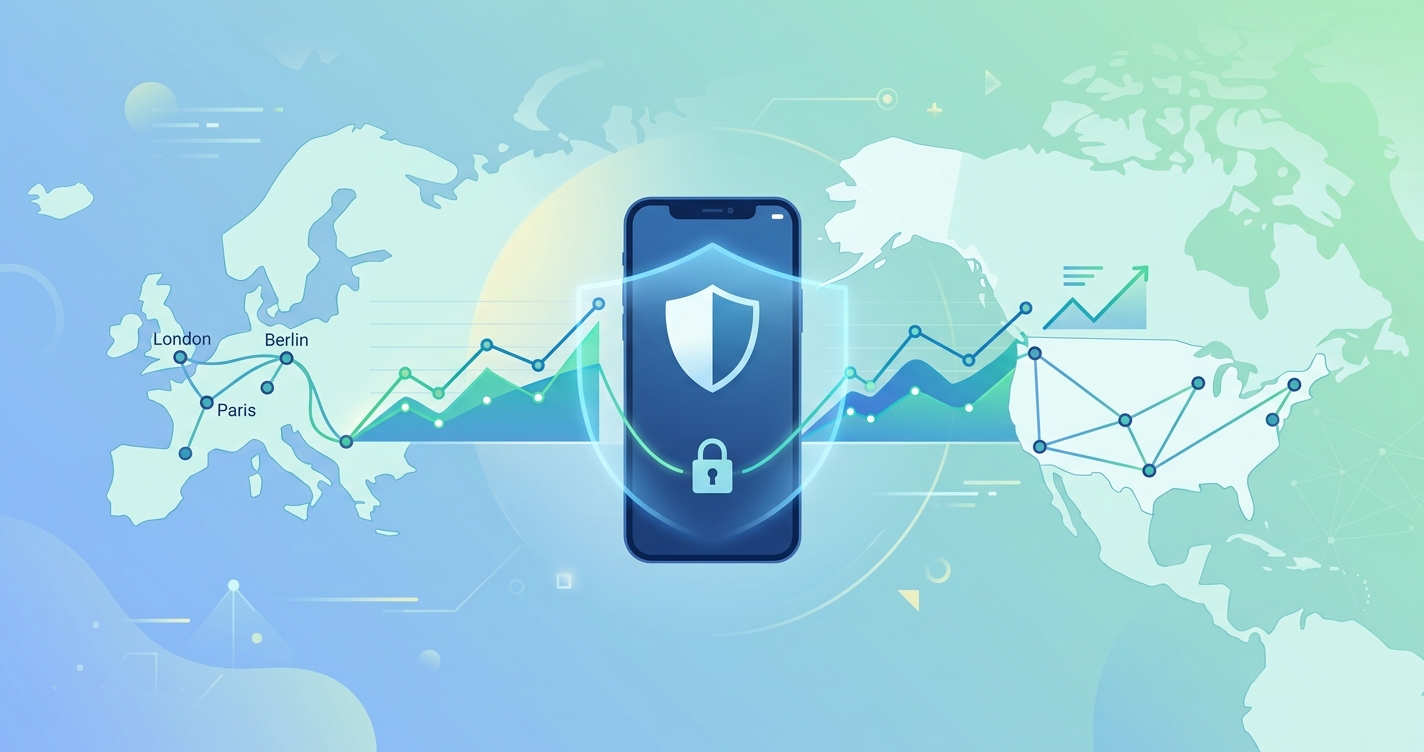
When engineering teams architect health platforms for global deployment, the compliance differences between the European Union and the United States often dictate the underlying infrastructure. A major architectural fault line emerges around the capture and processing of biometric information, particularly when integrating remote photoplethysmography (rPPG). The technical approach to vitals SDK data residency determines whether an application faces a streamlined security audit or a localized data center routing problem. Deploying a camera-based vital signs feature requires evaluating how the vendor handles raw video streams, numerical health outputs, and the geographic boundaries of where that data comes to rest.
For Chief Technology Officers and VP of Engineering roles, the procurement of a health software development kit is no longer just about accuracy and latency. The legal and technical risk associated with biometric data collection has forced engineering teams to scrutinize the data flow of every third-party integration. When a user points their smartphone camera at their face to measure their heart rate, the compliance clock starts ticking. Every millisecond of video captured, every frame processed, and every byte of resulting data stored must map to a highly regulated compliance matrix.
"In 2023, data protection authorities from 26 countries imposed 202 fines in the healthcare sector, totaling approximately 16.5 million Euros, highlighting the strict enforcement of biometric and identity data protections."
- GDPR Enforcement Tracker Report, CMS.law, 2024
The impact of vitals SDK data residency on app architecture
Remote photoplethysmography measures changes in blood volume by analyzing subtle color variations in the human face. Historically, computer vision features required sending raw media feeds to cloud servers for processing because mobile processors lacked the compute capabilities for real-time neural networks. In a healthcare context, routing raw facial video to a cloud server triggers immediate compliance liabilities. The video feed contains highly identifiable personal information, and transmitting it introduces points of vulnerability during network transport.
Processing health data on external servers forces engineering teams to build complex data residency routing logic. If an application serves users in Germany, Canada, and California, a cloud-dependent SDK requires the development team to ensure European video feeds are processed in Frankfurt data centers, Canadian data stays in Toronto, while American feeds remain in domestic instances. This creates a fragmented infrastructure that is difficult to maintain and expensive to scale.
To avoid these infrastructure overheads, modern integrations rely entirely on edge computing. By processing the rPPG signal directly on the hardware of the user device, the application never transmits raw biometric identifiers over the network. When evaluating an integration, technical leads should demand the following characteristics:
- Local processing of all RGB video frames within the volatile memory of the mobile device.
- Immediate destruction of raw video data and biometric pixels after the health metric is calculated.
- Transmission of only the final numerical outputs directly to the application database.
- Explicit controls over where the resulting numerical data is stored geographically, ensuring compliance with local mandates.
Comparing compliance architectures
The architectural requirements for contactless vitals change drastically depending on the regulatory environment.
| Compliance Parameter | US Requirements (HIPAA & State Laws) | EU Requirements (GDPR Article 9) | Recommended SDK Architecture |
|---|---|---|---|
| Data Classification | ePHI (if covered entity) or Consumer Health Data. | Special Category Data. | Process video locally; never store raw feeds. |
| Vendor Liability | Requires Business Associate Agreements (BAAs) for cloud processing. | Vendor acts as Data Processor; requires strict DPA. | On-device processing removes vendor from the data flow. |
| Cross-Border Transfer | Not strictly prohibited, but heavily regulated by vendor security controls. | Highly restricted; requires SCCs or adequacy decisions. | Generate numerical outputs locally; route to regional servers. |
| Consent Mechanisms | Driven by state laws (e.g., Washington MHMDA). | Requires explicit opt-in for biometric processing. | UI prompts must occur before the camera initializes. |
US health data storage and local processing rules
In the United States, the Health Insurance Portability and Accountability Act (HIPAA) governs the storage and transmission of electronic Protected Health Information (ePHI). While HIPAA does not explicitly ban cloud processing for health applications, it requires strict Business Associate Agreements (BAAs) with any third-party vendor that touches the data.
If a contactless vitals API transmits video to a cloud server to calculate heart rate, the API provider legally becomes a Business Associate. This forces the engineering team into a lengthy procurement cycle and compliance review. Furthermore, the regulatory environment in the US is rapidly fragmenting. Recent state-level legislation has introduced new complications that mirror European stringency. The Washington My Health My Data Act (MHMDA), enacted in March 2024, imposes strict consent and localized processing requirements for consumer health data. This act applies broadly to entities that collect health data from consumers in Washington, regardless of whether the entity is a traditional HIPAA covered entity.
By utilizing an SDK that performs all calculations on-device, the video feed never becomes ePHI in transit to a third party. The vendor never sees the data, meaning they never enter the chain of custody. The application only manages the resulting numerical data. The engineering team can encrypt these integers and store them in their own HIPAA-compliant backend, dramatically reducing the vendor risk surface and simplifying the compliance audit process.
EU Data Residency and GDPR Article 9
The European Union approaches health data with significantly stricter baseline controls. Under GDPR Article 9, health data and biometric data used for the purpose of uniquely identifying a natural person are classified as special category data. This classification requires explicit, informed user consent and mandates rigorous technical safeguards to prevent unauthorized access or processing.
While GDPR does not explicitly state that health data must physically remain within the borders of the European Economic Area (EEA), cross-border transfers require complex legal frameworks. Organizations must rely on Standard Contractual Clauses (SCCs) or adequacy decisions to transfer this sensitive information outside the EU. For healthcare platforms serving EU citizens, keeping data localized on European servers is not just the most defensible architecture; it is often the only practical path to rapid compliance.
A vitals SDK that relies on cloud processing introduces massive GDPR friction if its servers are located in the United States or other non-EEA regions. Even if the vendor encrypts the data during transit and at rest, European regulators increasingly scrutinize the transfer of special category data to foreign jurisdictions. On-device processing neutralizes this issue entirely. If the video feed never leaves the smartphone, no cross-border transfer of special category video data occurs. The application developer retains complete programmatic control over where the resulting numerical vitals data is stored. This allows the backend team to route the health metrics directly to their EU-based localized servers, completely bypassing international transfer restrictions.
Current research and evidence
The shift toward edge computing in optical health monitoring is heavily supported by recent computer science literature. In a 2024 publication in the IEEE Transactions on Circuits and Systems for Video Technology, researchers Yuzhen Ding, Yali Wang, and Yu-Gang Jiang from Fudan University detailed the architectural necessity of local processing in their paper "Privacy-Preserving Remote Photoplethysmography: A Survey."
The researchers systematically analyzed various methodologies for extracting physiological signals via camera sensors and concluded that localized, on-device processing is the most effective method for mitigating data leakage risks. By performing the signal extraction at the edge, applications eliminate the vulnerability window that occurs when transmitting high-resolution video streams across external networks. Their research validates that modern mobile processors, equipped with dedicated neural processing units, are fully capable of handling the computational load of rPPG algorithms without requiring external cloud compute power. This academic consensus aligns perfectly with the architectural demands of modern data privacy regulations.
The future of contactless vitals compliance
As consumer mobile devices become exponentially more powerful, the reliance on cloud infrastructure for biometric processing will become obsolete. Future regulatory frameworks, including the upcoming European Health Data Space (EHDS) expected to mature over the next few years, will likely codify the requirement for local processing of raw biometric feeds whenever technically feasible. The EHDS aims to give patients more control over their electronic health data, further emphasizing the need for decentralized processing architectures.
Engineering leaders should anticipate an environment where transmitting video for remote health analysis is heavily scrutinized by both app store reviewers and enterprise compliance officers. The standard architecture will universally consist of lightweight, highly optimized neural networks running directly on edge devices. This approach guarantees that data residency concerns are limited only to the final, lightweight numerical data. Platforms that adopt this architecture today will be immune to the jurisdictional complexities that plague older, cloud-dependent platforms.
Frequently asked questions
Does on-device processing automatically make an app HIPAA compliant?
No. While on-device processing prevents the SDK vendor from accessing user data, the application developer must still secure the resulting numerical health data. This includes encrypting data at rest on the device, encrypting data in transit to your servers, and maintaining proper access controls within your own infrastructure.
How does GDPR classify the video feed used for rPPG?
If the video feed is capable of identifying a natural person and is processed for the purpose of extracting health information, it falls under GDPR Article 9 as special category data. Avoiding the transmission of this video feed is critical for reducing compliance overhead and avoiding complex cross-border data transfer legalities.
Can we route European vitals data through US servers if it is fully encrypted?
It is highly discouraged. Even encrypted special category data transferred to the US requires complex legal mechanisms like Standard Contractual Clauses. Generating the health metrics on the local device and routing the encrypted numbers directly to an EU-based server is the recommended approach for maintaining strict data residency.
If your engineering team is evaluating how to build compliant health tracking, Circadify provides a drop-in rPPG SDK designed exclusively for edge processing. Our architecture ensures that raw video never leaves the user device, giving you complete control over your localized data storage. Review our privacy architecture and developer documentation at circadify.com/custom-builds to start building.