
Why does my doctor's app now let me check my vitals from home, in just one minute?
A technical look at telehealth vitals at home: how camera-based rPPG monitoring works, what engineering teams should evaluate, and where the field is heading.
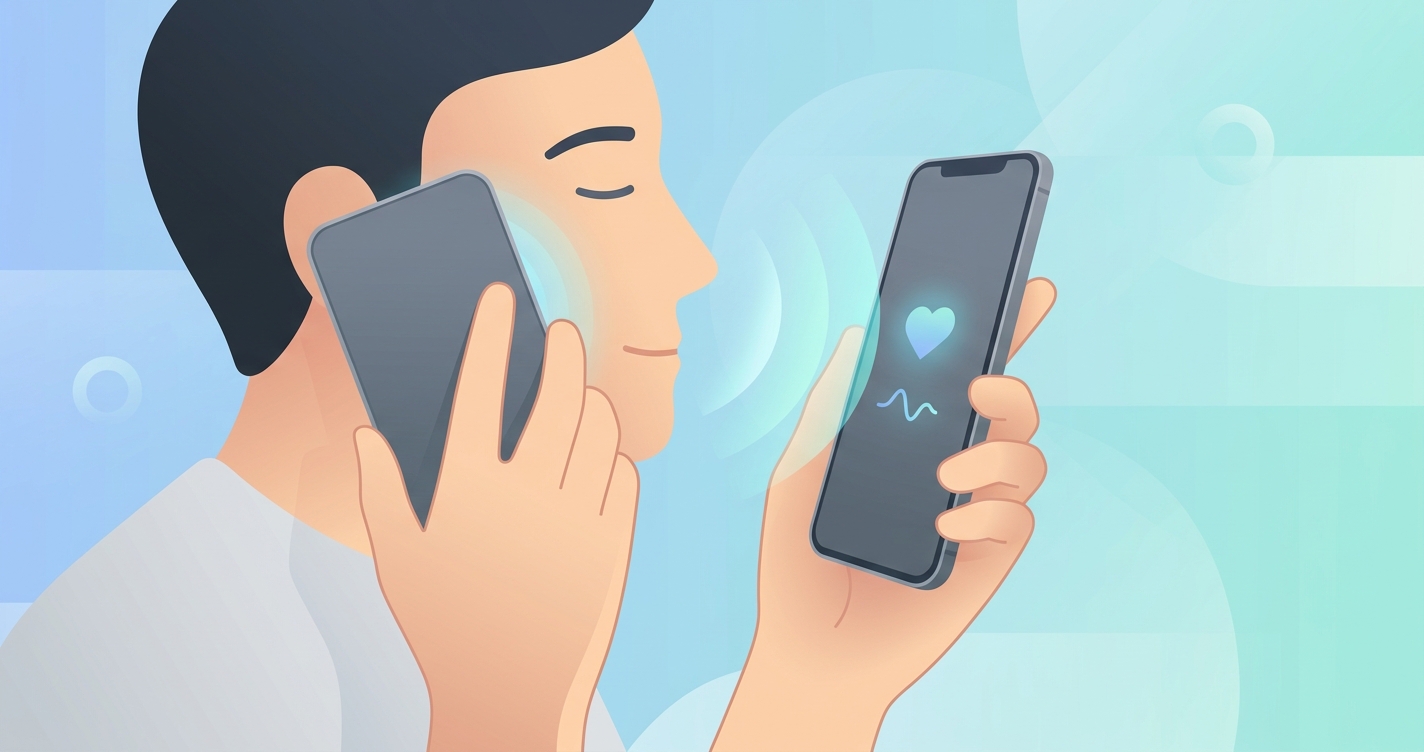
If you opened your provider's app recently and found a new option to read your heart rate, breathing rate, and other metrics by holding your phone to your face for sixty seconds, you witnessed a quiet architectural shift inside telehealth. The ability to check telehealth vitals at home, without a cuff, a clip, or a shipped device, is moving from research demos into production patient flows. For the engineering leaders building these platforms, the question is no longer whether camera-based measurement is possible. It is how to integrate it reliably, what it can and cannot measure, and how to do it without standing up a computer vision team from scratch.
The contactless vital signs monitoring market, which includes camera-based rPPG technology, was valued at roughly USD 1.4 billion in 2025 and is projected to reach USD 4.5 billion by 2035, according to WiseGuyReports market analysis (2025).
What "telehealth vitals at home" actually means under the hood
The technology behind a one-minute scan is remote photoplethysmography, or rPPG. When blood pulses through the capillaries just beneath the skin of your face, it changes how light is absorbed and reflected at a level invisible to the human eye but measurable by a standard RGB camera. An rPPG pipeline isolates those micro-fluctuations across frames, filters out motion and lighting noise, and reconstructs a pulse waveform. From that waveform a model can derive heart rate, heart rate variability, respiration rate, and related signals.
This matters for telehealth vitals at home because it removes the single largest friction point in remote patient monitoring: hardware logistics. No device to ship, configure, charge, pair, or replace. The patient already owns the sensor. For a CTO weighing program economics across thousands of enrolled patients, eliminating peripheral hardware changes the cost curve entirely.
The catch is that none of this is trivial to build. A working demo that reads a pulse in good lighting is achievable in days. A system robust enough for diverse skin tones, low light, head motion, and the messy reality of a patient's kitchen is a multi-year research problem. That gap is exactly where the build-versus-license decision sits for most teams.
Build in-house versus integrate a contactless vitals API
Engineering leaders evaluating camera-based vitals usually land on one of three paths. The trade-offs are less about raw capability and more about time to market, maintenance burden, and where your team's scarce expertise should go.
| Approach | Time to production | Engineering cost | Specialized expertise needed | Maintenance burden |
|---|---|---|---|---|
| Build rPPG in-house | 12-24 months | Very high | Computer vision, signal processing, ML research | Owned entirely by your team |
| Wearable hardware program | 3-6 months | High (per-unit + logistics) | Device management, firmware | Shipping, returns, battery support |
| Drop-in rPPG SDK / API | Days to weeks | Low to moderate | Standard mobile/web integration | Handled by the vendor |
A few practical observations that tend to drive the decision:
- The hard part of rPPG is not the happy path. It is the long tail of edge cases across lighting, motion, and skin tone that determines whether a feature is usable in production.
- Hardware programs solve accuracy but reintroduce the logistics cost that contactless monitoring was meant to remove.
- An SDK or API converts a research problem into an integration problem, which is the kind of problem product teams are already staffed to solve.
- The opportunity cost of pulling senior engineers onto a signal-processing project for a year is often larger than the licensing cost of a mature SDK.
Industry applications driving adoption
Remote patient monitoring programs
Chronic care management depends on regular vitals capture, and adherence collapses when patients have to manage a separate device. A camera-based check folds vitals into an app the patient already opens. Providers running hypertension, cardiac, or post-discharge programs can prompt a quick scan inside the existing visit flow rather than mailing equipment.
Virtual urgent care and triage
During a video consultation, a clinician currently has to ask the patient to self-report or read from a home device of unknown calibration. Embedding a contactless scan into the same session gives the clinician structured data points to inform triage decisions in real time, without breaking the consultation.
Onboarding and intake
Intake questionnaires increasingly include a baseline vitals capture. A sixty-second scan during onboarding produces a consistent starting record across an entire patient population, which is far more uniform than asking everyone to use whatever equipment they happen to own.
Employer and population health
Large-scale wellness and screening programs cannot ship a device to every employee. A camera-based scan delivered through a white-label app lets a population health platform reach an entire workforce with the same measurement method.
Current research and evidence
The scientific foundation for camera-based vitals continues to mature. A 2024 comprehensive review published in the journal Electronics (MDPI) by S. M. R. Islam, M. A. H. Akhand, and colleagues surveyed rPPG methods for heart rate and respiration rate estimation, concluding that accuracy in controlled conditions is generally high while real-world robustness across motion and lighting remains the central engineering challenge.
The same body of literature is consistent on an important nuance for product teams: not all vitals are equally mature. Heart rate and respiration rate estimation from facial video are well supported. Blood pressure estimation from rPPG is an active research area where the reviewers caution that clinical reliability is still under development and requires further validation. Responsible product design treats these as wellness and informational signals rather than diagnostic outputs, and keeps clinical decision authority with a clinician.
The market data reflects growing confidence in the category. Beyond the contactless segment figures cited above, the broader remote patient monitoring market was estimated across analyst reports in 2025 in ranges spanning tens of billions of dollars, with Fortune Business Insights and Precedence Research both projecting sustained double-digit growth through the early 2030s. The drivers are consistent across reports: aging populations, chronic disease prevalence, and patient demand for home-based care.
Key takeaways from the evidence base:
- Heart rate and respiration rate from facial video are the most validated metrics today.
- Blood pressure and SpO2-style outputs require careful framing and ongoing validation.
- Skin tone fairness and motion tolerance are the metrics that separate lab results from production performance, so they belong in any vendor evaluation.
The future of telehealth vitals at home
Three trends are worth watching for teams planning roadmaps. First, the measurement surface is widening. As models improve, the set of metrics derivable from a single passive video stream grows, which means a feature integrated today can expand in capability without changing the patient interaction. Second, on-device processing is becoming the default. Running inference locally rather than streaming raw video to a server reduces latency, lowers bandwidth cost, and simplifies the privacy and compliance posture, since sensitive imagery never leaves the phone. Third, regulatory frameworks are catching up, and the distinction between wellness signals and regulated diagnostic claims will keep shaping how these features are marketed and deployed.
For engineering leaders, the strategic implication is that camera-based vitals is shifting from a differentiating bet to a baseline expectation. Patients who experience a one-minute scan in one app will expect it in the next. The teams that win will be the ones who integrate quickly, frame the outputs responsibly, and reserve their engineering capacity for the parts of the product only they can build.
Frequently asked questions
How can a phone camera measure vitals without any sensor touching me?
The camera is the sensor. Remote photoplethysmography detects tiny color changes in facial skin caused by blood flow with each heartbeat. Software isolates that signal across video frames and reconstructs a pulse waveform, from which heart rate and related metrics are derived. No contact is required because the optical signal travels through ordinary light.
Is camera-based measurement accurate enough for clinical use?
Heart rate and respiration rate from facial video are well supported in peer-reviewed research under reasonable conditions. Metrics like blood pressure remain active research areas where clinical reliability is still being validated. Most responsible deployments treat these outputs as wellness and informational signals and keep diagnostic decisions with a clinician.
Should our team build rPPG ourselves or license an SDK?
Building a production-grade rPPG pipeline is a multi-year research effort covering computer vision, signal processing, and fairness across skin tones and lighting. Licensing a mature SDK converts that research problem into a standard integration task, typically measured in days to weeks. The right choice depends on whether camera-based vitals is core intellectual property for your business or a feature you need to ship reliably and soon.
What about patient privacy with video-based vitals?
Modern implementations increasingly process video on the device itself, so raw imagery never leaves the phone and only derived metrics are transmitted. This architecture reduces bandwidth, lowers latency, and simplifies compliance compared with streaming video to a server for processing.
Circadify is building developer infrastructure for exactly this space: a drop-in rPPG SDK that lets engineering teams add contactless vitals to an existing app in days rather than months, without standing up a computer vision research group. If you are evaluating how to bring telehealth vitals at home into your platform, explore the developer docs and request API keys at circadify.com/custom-builds.