
Skin Tone Bias in Camera-Based Vitals: What to Test
A procurement guide to skin tone bias rPPG accuracy: how CTOs validate equitable contactless vitals across Fitzpatrick types before integrating a health SDK.
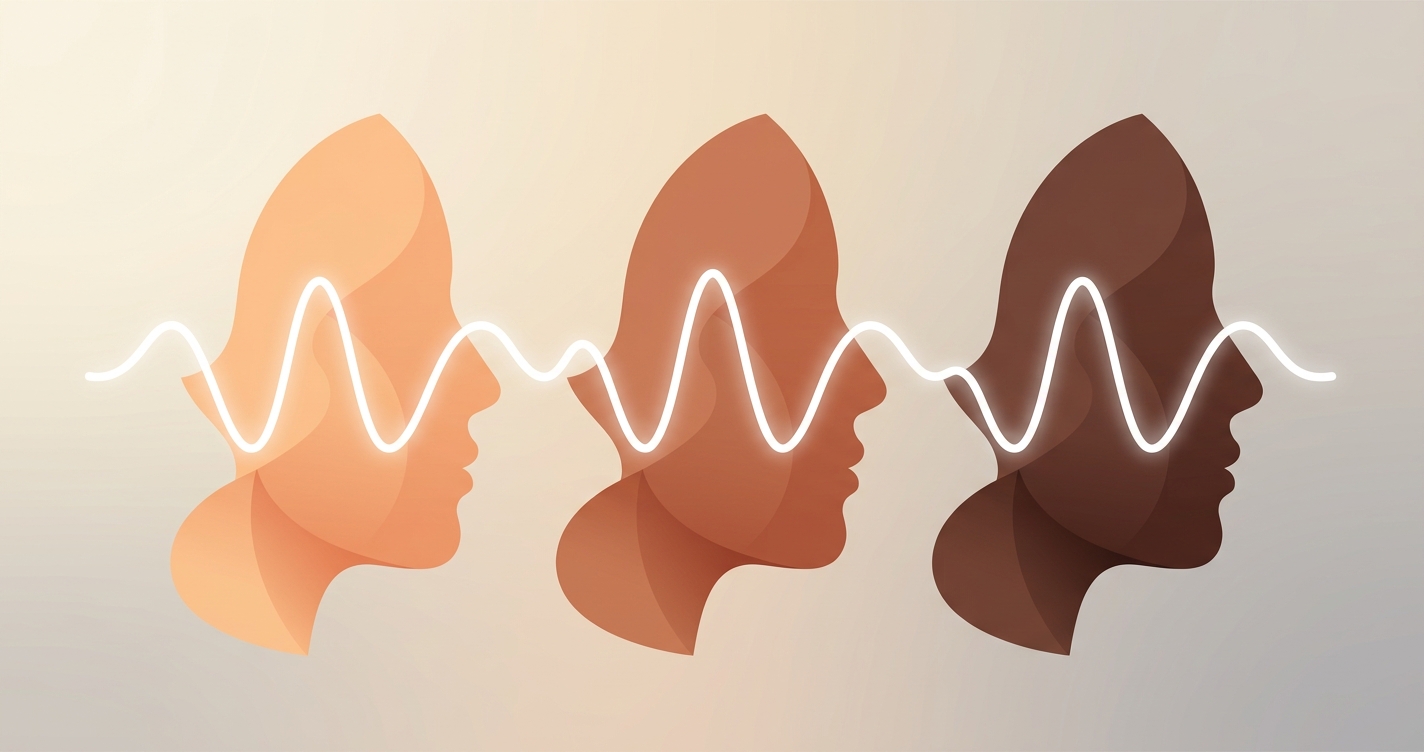
Any engineering leader shipping camera-based vital signs inherits a problem that predates the technology by decades: optical measurement of physiology has a documented history of working less reliably on darker skin. The question of skin tone bias rPPG accuracy is no longer academic for a health platform CTO. It is a procurement gate, a regulatory exposure, and an equity commitment that shows up in your error logs whether or not you measured for it. Remote photoplethysmography (rPPG) reads the blood volume pulse from minute color changes in facial skin captured by an ordinary RGB camera. Melanin absorbs light in the same visible bands rPPG depends on, which means the raw signal is physically weaker for users with higher pigmentation. If your validation plan does not stratify by skin tone, you are not measuring accuracy. You are measuring accuracy for the demographic that happened to dominate your test set.
A 2020 study led by Michael Sjoding at the University of Michigan, published in the New England Journal of Medicine, found that Black patients had nearly three times the frequency of occult hypoxemia missed by pulse oximetry compared with White patients. The same optical physics that biased that contact device is present in every camera-based vitals pipeline.
Why skin tone bias in rPPG accuracy is a physics problem, not a bug
The bias starts before any model runs. Melanin in the epidermis attenuates green and blue wavelengths most strongly, and green is precisely where the cardiac signal is richest because hemoglobin absorbs it well. The result for Fitzpatrick types V and VI is a lower signal-to-noise ratio at the sensor, before any algorithm gets a chance to recover the pulse. Monte Carlo reflectance simulations published in MDPI have modeled this attenuation directly, confirming that pigmentation reduces the recoverable pulsatile component independent of camera quality.
Two compounding factors make it worse in practice. First, most public rPPG datasets skew light. A demographic audit of public rPPG benchmarks by researchers at ETH Zurich (Schrumpf and colleagues) found that widely used training corpora are dominated by lighter skin tones, so models inherit the bias of their data. Second, automatic camera exposure and white balance are tuned for the same majority, which can underexpose darker faces and further degrade the input. Fairness in contactless vitals is therefore a stack problem spanning optics, exposure control, dataset composition, and algorithm design. Fixing one layer while ignoring the others produces a product that passes a demo and fails a cohort.
Krish Kabra and collaborators at Rice University demonstrated that a diverse rPPG approach, with training data deliberately balanced across skin tones, narrowed the heart rate error gap that appears when models are trained on skewed data. A UCLA team led by researchers in Aydogan Ozcan's group has separately published methods to reduce the disparity in remote heart rate sensing for darker skin. The takeaway for a buyer is that the gap is real, measurable, and addressable, which means a vendor has no excuse for not reporting it.
What to actually test during procurement
When you evaluate a contactless vitals SDK, the difference between a fair product and a biased one is not in the marketing claim. It is in the stratified error table the vendor can or cannot produce. Demand the breakdown below, and treat a single pooled accuracy number as a red flag.
| Validation dimension | Weak vendor evidence | Evidence to require |
|---|---|---|
| Skin tone stratification | One pooled MAE across all users | Error reported per Fitzpatrick group, ideally I-II, III-IV, V-VI |
| Sample size per group | "Diverse dataset" with no counts | n per skin tone group, with V-VI adequately powered |
| Pigmentation measure | Self-reported race only | Fitzpatrick scale plus objective ITA (Individual Typology Angle) |
| Reference standard | Another consumer device | ECG for heart rate, capnography or chest band for respiration |
| Conditions tested | Bright lab lighting only | Low light, mixed lighting, motion, varied camera hardware |
| Metric transparency | "Clinically accurate" | MAE, RMSE, bias, limits of agreement (Bland-Altman) per group |
| Failure handling | Silent low-confidence output | Confidence scores and explicit measurement rejection |
A practical demographic validation health SDK checklist for your evaluation team looks like this:
- Require error metrics segmented by Fitzpatrick type, not just an aggregate. Aggregates hide the exact population you are accountable to.
- Insist on an objective pigmentation measure. ITA derived from calibrated color is reproducible in a way self-identified race is not.
- Check the sample size for the darkest groups. A study with 200 participants and only 12 in types V-VI cannot support a fairness claim.
- Validate against a true reference, such as ECG for heart rate, rather than chaining one estimate to another.
- Test in your real conditions: the lighting, camera models, and motion your users will actually present.
- Examine how the SDK behaves when the signal is poor. An honest low-confidence rejection is safer than a confident wrong number.
Industry applications and where the risk concentrates
Telehealth and remote patient monitoring
In a remote hypertension or post-discharge program, a missed or distorted vital is a clinical signal lost. If accuracy degrades for a subset of enrolled patients, the program quietly delivers worse care to the people it most needs to reach. Stratified validation is the only way to know your monitoring is equitable before you scale a cohort.
Insurance and member wellness
Carriers using camera-based vitals for member engagement face both reputational and regulatory exposure if outcomes differ systematically by demographic. An inclusive vital signs API that documents performance across skin tones is a defensible position; an undocumented one is a liability waiting for an audit.
Consumer health and fitness
Even in non-clinical wellness contexts, a feature that visibly works for some users and not others erodes trust fast. App store reviews surface these gaps quickly, and they map onto demographics in ways that are hard to walk back.
Current research and evidence
The clinical record is what gives this issue weight. Sjoding's 2020 NEJM analysis put the occult hypoxemia disparity in front of regulators, and subsequent meta-analyses confirmed higher occult hypoxemia prevalence and worse downstream outcomes for patients with darker skin. In January 2025 the U.S. FDA issued draft guidance recommending that pulse oximeter premarket studies enroll participants across the full range of skin pigmentation and report results using objective measures. That regulatory direction signals where camera-based vitals scrutiny is heading next.
On the rPPG side specifically, the evidence is converging on a clear pattern. The ETH Zurich dataset audit established that the data feeding most models is biased. Studies in 2023 and 2024 on filtering and signal processing across skin tones, including work indexed through PubMed Central on biases in rPPG methods, show that error often rises for Fitzpatrick V-VI under naive pipelines, while purpose-built methods can shrink the gap. The honest reading of the literature is that bias is the default outcome and equity is an engineering achievement that must be measured to be claimed.
The future of fairness in contactless vitals
Three shifts are coming. First, regulatory expectations set for contact oximetry will extend by analogy to camera-based measurement, making stratified reporting a baseline rather than a differentiator. Second, objective pigmentation metrics like ITA will displace self-reported race in serious validation work because they are reproducible and camera-native. Third, multi-wavelength and sensor-fusion approaches, including red and near-infrared bands that melanin absorbs less, will reduce the physical signal gap rather than only correcting for it downstream. For buyers, the durable strategy is to treat melanin rPPG accuracy as a first-class acceptance criterion with its own test plan, not a footnote in a general benchmark. The vendors who survive scrutiny will be the ones who publish the uncomfortable per-group numbers instead of the comfortable averages.
Frequently asked questions
How do I know if a vitals SDK is biased by skin tone?
Ask for error metrics stratified by Fitzpatrick type with sample sizes per group, validated against a gold-standard reference such as ECG. If a vendor can only provide a single pooled accuracy figure, you cannot rule out bias, because aggregates mask group-level disparities.
What is the difference between Fitzpatrick scale and ITA for validation?
The Fitzpatrick scale is a six-point clinical classification that is useful but partly subjective. ITA (Individual Typology Angle) is an objective measure derived from calibrated skin color values. Strong demographic validation reports both, with ITA giving reproducibility that self-reported categories cannot.
Does skin tone bias affect heart rate and respiration equally?
Both can be affected because both depend on the optical signal, but the magnitude varies by metric and method. Heart rate from rPPG is generally more robust than blood pressure or oxygen estimates. You should require separate per-metric, per-skin-tone results rather than assuming parity across vitals.
Is this a solved problem with modern algorithms?
No. Research shows purpose-built models and balanced training data can narrow the gap substantially, but bias remains the default when datasets are skewed or pipelines are naive. Equity has to be measured and demonstrated for your conditions, not assumed from a model architecture.
Circadify is building its rPPG SDK with stratified, demographic validation as a core part of how performance is documented rather than an afterthought, so engineering teams can review fairness data alongside accuracy data before they commit. If you are evaluating contactless vitals and need per-group evidence to clear procurement, request developer docs, API keys, and the clinical validation and fairness details at circadify.com/custom-builds.