How can my phone understand my stress levels just by looking at my face for 30 seconds?
A technical look at how phone stress detection works: rPPG extracts HRV from facial video to infer autonomic stress, and what it means for wellness app teams.
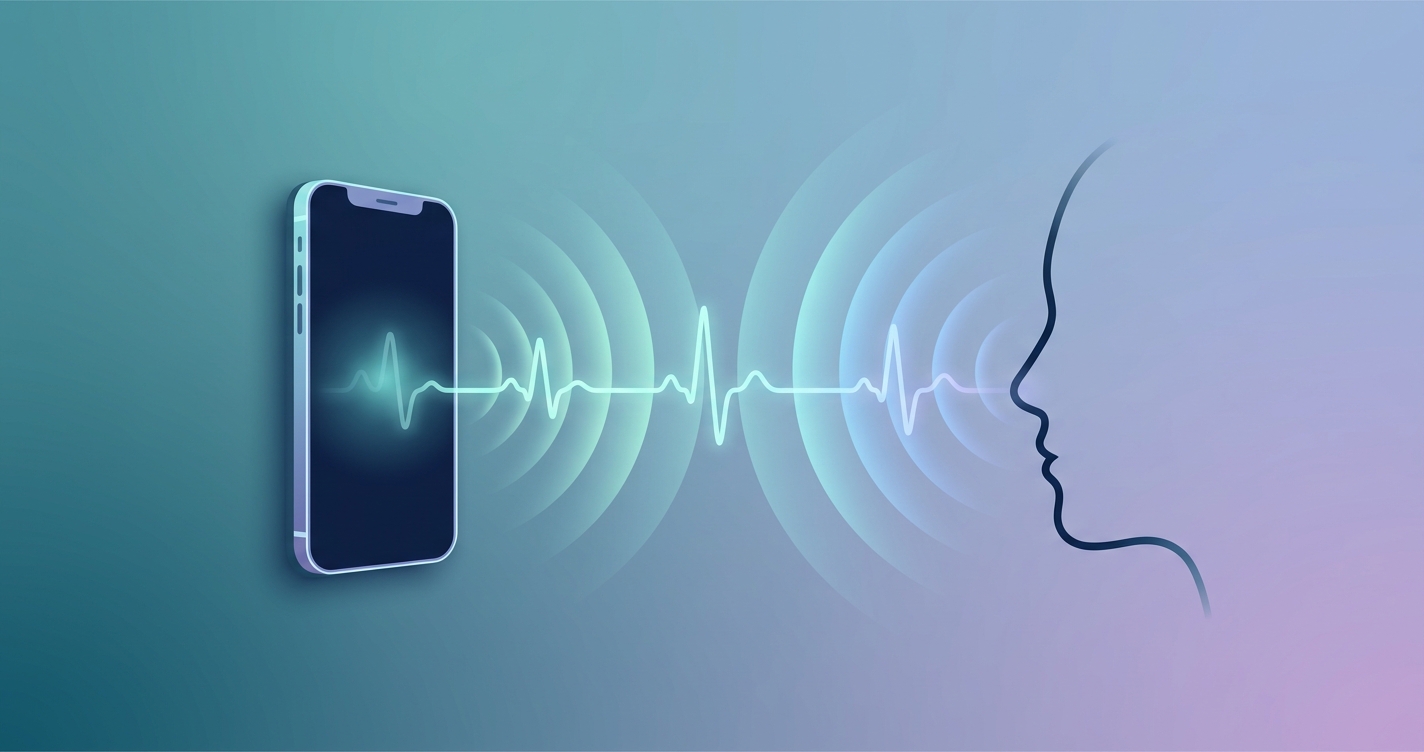
A front-facing camera and 30 seconds of footage now carry enough signal to estimate a user's autonomic state. The mechanism behind phone stress detection is not facial expression reading in the way most product teams assume. It is remote photoplethysmography (rPPG): the same RGB sensor that captures a selfie picks up tiny, periodic color shifts in the skin caused by blood flowing through the capillaries under the face. From that pulse waveform, a model reconstructs heart rate variability (HRV), the spacing between consecutive beats, which is one of the most validated proxies for sympathetic and parasympathetic nervous system activity. For developer teams at wellness apps, this means a stress feature can ride on hardware every user already owns, with no wearable, no finger clip, and no additional bill of materials.
"rPPG technology measures blood volume pulse from facial videos by detecting subtle changes in skin color corresponding to heartbeats, and HRV, a key biomarker related to the autonomic nervous system, can be extracted from those signals.", Juncong Xu, Cheng Song, Zijie Yue, and Shuai Ding, MTASR stress recognition study, 2024
How phone stress detection actually works
Phone stress detection is a pipeline, not a single model. Understanding each stage matters because the failure points and accuracy ceilings live in different places.
The first stage is face detection and region-of-interest tracking. The system locks onto stable skin patches, typically the forehead and cheeks, because these areas have dense capillary beds and move less than the mouth or eyes. The second stage extracts the raw rPPG signal by averaging color channels across those regions frame by frame, then filtering out motion and lighting noise. The third stage reconstructs the blood volume pulse and derives inter-beat intervals. The fourth stage computes HRV features such as RMSSD and SDNN, and a classifier maps those features to a stress estimate.
The reason 30 seconds is the common window is statistical. Short-term HRV metrics like RMSSD stabilize within roughly 30 to 60 seconds of clean signal. Less than that and the inter-beat interval sample is too small to be reliable. Much more than that and you lose users who will not hold still.
What the camera is reading is not emotion. It is physiology. When the sympathetic nervous system activates under stress, heart rate tends to rise and beat-to-beat variability tends to compress. The model infers the autonomic shift from the pulse, then optionally fuses it with facial-expression features for a second, weaker signal. This distinction is the single most important thing for a product team to internalize: a robust stress feature is built on the cardiovascular signal first, with expression analysis as a supporting layer.
| Approach | Signal source | Hardware needed | Typical session | Integration effort |
|---|---|---|---|---|
| rPPG from facial video | Capillary blood volume pulse to HRV | Standard front camera | 20 to 30 seconds | Drop-in SDK |
| Contact PPG wearable | Optical sensor at wrist or finger | Dedicated device | Continuous | Hardware plus pairing |
| Facial expression only | Action units, micro-expressions | Standard front camera | A few seconds | Vision model only |
| Self-report survey | User input | None | 1 to 3 minutes | Form logic |
A few practical observations follow from that comparison:
- rPPG is the only camera-only method that reads a physiological signal rather than an inferred behavioral one.
- Expression-only systems are cheap to build but easy to fool and weakly correlated with autonomic stress.
- Wearables give continuous data but exclude every user who does not own or wear one.
- Self-report is the baseline most wellness apps already ship, and it is exactly what a passive scan can augment.
Industry applications for wellness app teams
The value of a 30-second scan is that it converts a passive moment into a data point without asking the user to do anything they would not already do.
Mental wellness and meditation apps
A pre-session and post-session scan brackets a breathing or meditation exercise with a measurable autonomic delta. Instead of asking "do you feel calmer," the app shows an HRV shift. That before-and-after framing is a retention mechanic as much as a health feature, because it gives users visible proof the product worked.
Corporate and occupational wellness
Employers running wellness programs want aggregate, de-identified trend data on workforce stress without distributing hardware. A camera-based check-in inside an existing app scales to thousands of employees with zero device logistics. The same studies that report high stress-classification accuracy in lab settings, up to the mid-90s percent range on public datasets, also caution that real-world conditions degrade performance, so these deployments should treat output as a wellness signal, not a diagnosis.
Fitness and recovery platforms
HRV is already a recovery and readiness indicator in athletic training. A morning face scan can feed a readiness score that tells a user whether to push a hard session or recover, all without a chest strap.
Current research and evidence
The peer-reviewed base under phone stress detection has matured quickly. In 2024, Juncong Xu, Cheng Song, Zijie Yue, and Shuai Ding introduced MTASR, a multi-task attentional convolutional network that extracts rPPG from RGB facial video and treats peak detection and heart rate estimation as auxiliary tasks. On the public UBFC-Phys dataset, it reported 94.33 percent accuracy for binary stress-state recognition and 83.83 percent for finer-grained stress-level recognition. The gap between those two numbers is instructive: detecting whether someone is stressed is meaningfully easier than grading how stressed they are.
Separate work on HRV extraction quality is just as relevant. A 2023 line of research on robust HRV measurement from facial video, including methods like WaveHRV, achieved low mean absolute error for RMSSD and SDNN under controlled conditions. But the same body of literature is candid about limits. Reviews note that rPPG accuracy for pulse rate can drop sharply at elevated heart rates, and that individual-level HRV estimates are less reliable than group-level ones. Lighting, skin tone diversity, and motion remain the dominant error sources.
For a developer team, the takeaway is to design around these constraints rather than ignore them:
- Validate against the conditions your users actually scan in, not a lab.
- Surface a confidence or signal-quality indicator and discard low-quality reads.
- Position output as a wellness trend, never a clinical measurement.
The future of phone stress detection
Three shifts are visible in the current research direction. First, multi-task and multimodal models that fuse the cardiovascular signal with facial expressions are closing the gap on stress-level grading, not just stress detection. Second, on-device inference is becoming the default, which keeps raw facial video off the network and simplifies the privacy story that matters most for health data. Third, the field is actively working on robustness across skin tones, lighting, and motion, the exact conditions that separate a lab demo from a shippable feature.
For wellness app teams, the strategic point is that the underlying signal processing is hard, slow to build, and harder to validate, while the user-facing feature is simple to describe. That asymmetry is why most teams license the scanning layer instead of building rPPG from scratch.
Frequently asked questions
Does phone stress detection read my facial expressions? Primarily no. The core signal is remote photoplethysmography, which reads pulse-driven color changes in the skin to estimate heart rate variability. Some systems add facial-expression analysis as a secondary input, but the autonomic stress estimate comes from the cardiovascular signal.
Why does it need a full 30 seconds? Short-term HRV metrics such as RMSSD need roughly 30 to 60 seconds of clean pulse data to stabilize. A shorter window produces too few inter-beat intervals for a reliable estimate, while a longer one hurts completion rates.
How accurate is camera-based stress detection? Published models report stress-state classification in the low-to-mid 90s percent on public datasets, with stress-level grading notably lower. Real-world lighting, motion, skin tone, and elevated heart rates reduce accuracy, so output should be framed as a wellness signal rather than a medical reading.
Can we add this without building computer vision in-house? Yes. The signal extraction, HRV reconstruction, and quality control are the hard parts, and they are available as a drop-in SDK so a wellness app can expose a stress-scan feature in days rather than months.
Circadify is building developer tooling for exactly this space: a drop-in rPPG SDK that turns a standard front camera into a contactless vitals and HRV source, so your team can ship a stress-scan feature without standing up a computer vision pipeline. Explore the developer docs and request API keys at circadify.com/custom-builds.