How can my phone become a health scanner, just by using its camera, before I leave the house?
A developer-focused look at how a phone camera health check works, what rPPG measures in 30 seconds, and how teams can ship camera-based vitals fast.
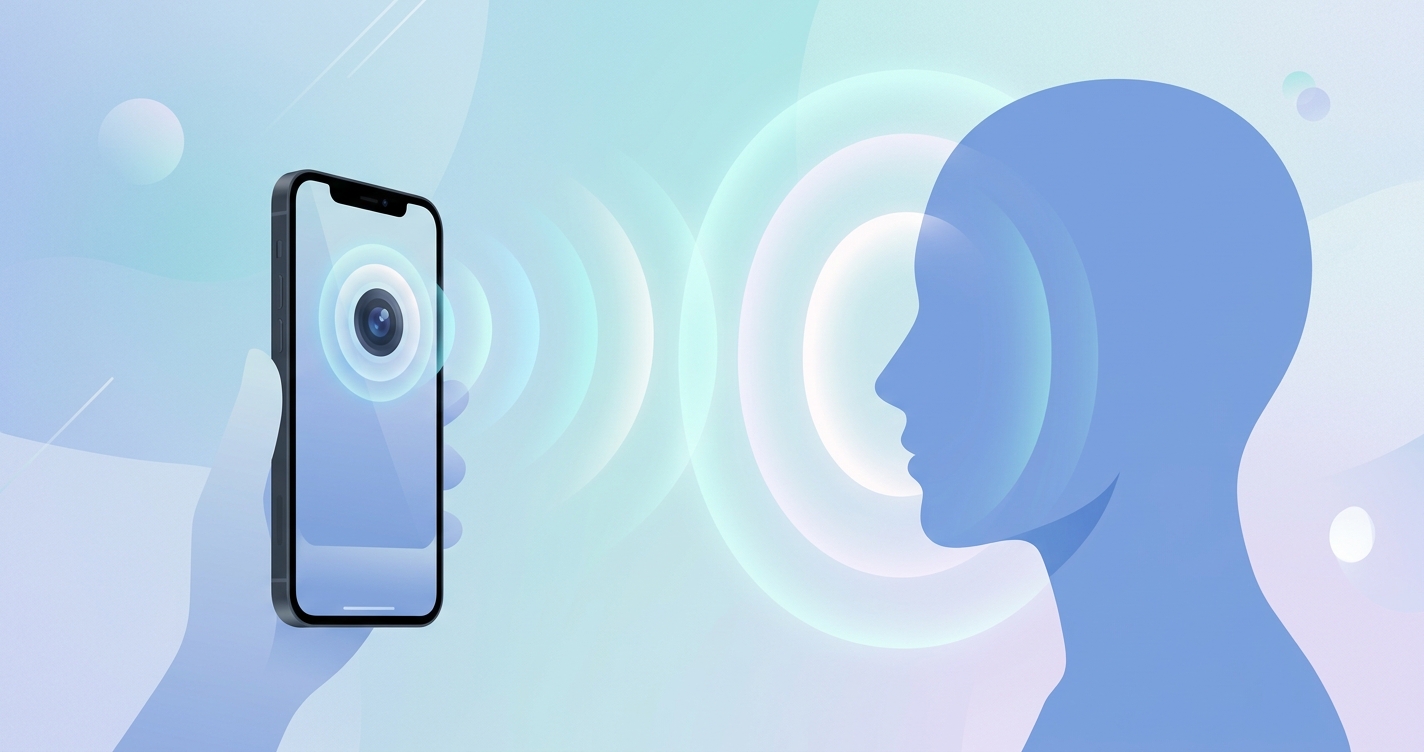
The phone already sitting in your pocket holds a sensor good enough to read your pulse off the skin of your face. A morning phone camera health check works because the same RGB camera that takes a selfie can detect tiny, periodic color shifts in the skin as blood pulses through capillaries just beneath the surface. That signal, invisible to the eye, is what remote photoplethysmography (rPPG) extracts and turns into heart rate, respiratory rate, and a growing list of derived metrics. For developer teams at health platforms, the interesting question is not whether the camera can do this. It is how reliably, how fast, and how cleanly it can be wired into an app that users already open every day.
A 2024 updated systematic review and meta-analysis led by researchers at Lancaster University found smartphone photoplethysmography heart rate agreement with electrocardiography reaching correlation coefficients between r = 0.98 and r = 1.0 under controlled conditions, putting a 30-second reading well inside the range product teams care about.
What a phone camera health check actually measures
A phone camera health check is not a single measurement. It is a pipeline. The camera captures a short video of the face or a fingertip, a region-of-interest tracker isolates skin pixels, and a signal-processing or deep-learning stage separates the pulsatile blood-volume signal from noise caused by motion, lighting, and compression. From that recovered waveform, the system estimates heart rate first, then respiratory rate from the slow modulation of the same signal, and increasingly heart rate variability and stress proxies.
The strength of the approach is that it removes hardware. No chest strap, no finger clip, no smartwatch pairing flow. A user opens the app before leaving the house, holds steady for half a minute, and gets a reading. The cost is that the camera is an uncontrolled sensor. Ambient light, skin tone, device model, and even how the user holds the phone all change the raw input. That is why the engineering effort sits less in capturing video and more in making the estimate robust across real conditions.
Two acquisition modes dominate in production apps, and they trade convenience against signal quality:
| Approach | How it works | Signal strength | User friction | Best fit |
|---|---|---|---|---|
| Contact fingertip (camera + flash) | Finger covers lens, flash illuminates blood flow | High, strong pulsatile signal | Medium, user must cover lens steadily | Quick spot heart rate checks |
| Contactless facial rPPG | Front camera films face under ambient light | Moderate, sensitive to light and motion | Low, hands-free and natural | Daily wellness scans, telehealth intake |
| Dedicated wearable | Optical sensor on wrist or finger | High, continuous | Hardware purchase and charging | Continuous monitoring |
| Clinical pulse oximeter | Transmissive light through finger | Reference grade | Requires dedicated device | Clinical settings |
For a daily pre-departure check, contactless facial rPPG wins on friction, which is usually what drives adoption. The fingertip method tends to produce a cleaner waveform but breaks the hands-free experience that makes a camera scan feel effortless.
Why the camera-based approach is gaining ground
A few factors push camera-based vitals from novelty toward a default feature for health apps:
- The sensor is already in every device, so there is zero hardware cost and no supply chain to manage.
- A reading takes 20 to 60 seconds, short enough to fit a morning routine.
- Front cameras have improved in resolution, frame rate, and low-light performance across recent device generations.
- Machine-learning models now handle motion and lighting variation far better than the early fixed-algorithm methods.
- Users increasingly expect health features inside apps they already use, rather than a separate dedicated app.
The catch for developers is that none of this is trivial to build from scratch. Region tracking, signal extraction, motion rejection, and per-device calibration each represent months of specialized work. This is the gap that camera-based vitals developer tools are meant to close, packaging the pipeline behind an SDK or API so a product team integrates a feature instead of researching a field.
Industry applications for camera-based vitals
Telehealth intake
A patient joining a video consult can complete a passive vitals capture while waiting for the clinician. The same front camera that powers the call records a baseline heart rate and respiratory rate, giving the provider context before the conversation starts. Because the capture rides on hardware the patient already owns, it works for the large group of users who have no wearable.
Wellness and fitness
A pre-workout or morning scan gives users a daily snapshot and a trend line over time. Here the value is consistency rather than clinical precision. A reading taken the same way each morning surfaces meaningful changes, and the low friction of a contactless scan keeps users coming back.
Insurance and corporate health
Periodic check-ins inside a wellness or insurtech app can prompt a quick camera scan to log engagement and trend data, with the heavy lifting handled server side or on device. The convenience of a phone camera health check makes voluntary, repeated participation realistic in a way that mailing out hardware never was.
Current research and evidence
The evidence base for camera-based vitals has matured quickly. Beyond the Lancaster University meta-analysis of smartphone photoplethysmography, a prospective validation study published in PMC reported a mean absolute percentage error of roughly 1.6 percent for heart rate measured from a short smartphone capture, with the method holding up across a range of skin tones. That cross-skin-tone robustness is the single most scrutinized failure mode for camera-based health tech, and recent work treats it as a primary benchmark rather than an afterthought.
Google Research has described a passive heart-health monitoring system using the smartphone camera that achieved a mean absolute percentage error under 10 percent against ECG across all skin tones, a threshold often cited as the bar for this category. On the contactless side, a clinical validation study published in PMC tested rPPG-based pulse rate software in cardiovascular disease patients and reported strong agreement with ECG, an encouraging signal because that population is harder to measure than healthy volunteers.
Blood pressure remains the frontier. A 2025 review in OAE Publishing on camera-based rPPG for blood pressure measurement described current evidence as promising but not yet settled, with cuffless camera estimates still facing calibration and generalization challenges. The honest read for product teams is that heart rate and respiratory rate are ready for consumer features today, while blood pressure and oxygen saturation sit closer to active research than reliable production.
A practical takeaway from the literature: reported accuracy depends heavily on acquisition conditions. The same review work that documents tight ECG agreement also flags lighting, motion, and reporting inconsistency as the main reasons published numbers vary. That is an integration problem as much as a science problem, which is exactly why how a feature is built matters as much as which model sits underneath.
The future of the phone camera health check
The direction of travel is toward more metrics from the same 30 seconds of video and toward measurements that survive messier real-world conditions. Several threads stand out:
- Multi-modal, multi-task models that estimate several vitals from one capture, reducing the user to a single short scan.
- On-device inference that keeps raw video off the network, lowering latency and easing privacy and compliance concerns.
- Broader regulatory recognition, with the first contactless pulse-rate mobile apps reaching FDA clearance in 2025, signaling a path for camera vitals into more regulated contexts.
- Tighter integration into existing flows, so a check happens passively during a video call or app open rather than as a separate task.
For engineering leaders, the build-versus-integrate calculus keeps shifting toward integrate. The research field is moving fast, device fragmentation is real, and maintaining a robust pipeline across the full Android and iOS device matrix is a continuing cost, not a one-time project. A drop-in rPPG SDK lets a team ship a camera scan in days and inherit ongoing model and device-coverage improvements instead of owning that maintenance burden.
Frequently asked questions
How long does a phone camera health check take?
Most implementations need 20 to 60 seconds of steady capture. Shorter windows reduce friction but give the signal-processing stage less data to reject noise, so 30 seconds is a common balance between speed and stability.
Is a contactless face scan as accurate as a finger clip?
For resting heart rate under good conditions, published studies report close agreement with ECG and pulse oximetry. A finger clip remains the reference for oxygen saturation, and camera-based blood pressure is still emerging. Match the metric to what the research currently supports.
Do these scans work across different skin tones?
Recent validation work treats cross-skin-tone performance as a core requirement, and several systems report consistent accuracy across tones. It depends on the model and training data, so teams should confirm coverage rather than assume it.
Can the processing run on the device instead of the cloud?
Yes. On-device inference is increasingly common and helps with latency and privacy by keeping raw video local. The right choice depends on your device targets and data-handling requirements.
Circadify is building developer tools for exactly this space, a drop-in rPPG SDK that lets health platforms add a contactless camera scan without assembling the pipeline themselves. If you are evaluating how to bring a phone camera health check into your product, the developer docs and API keys at circadify.com/custom-builds are the place to start.