
How accurate is a phone vitals scan compared to a finger clip?
A comparison of phone vitals accuracy vs pulse oximeter performance, exploring the underlying technology, validation studies, and use cases for developers.
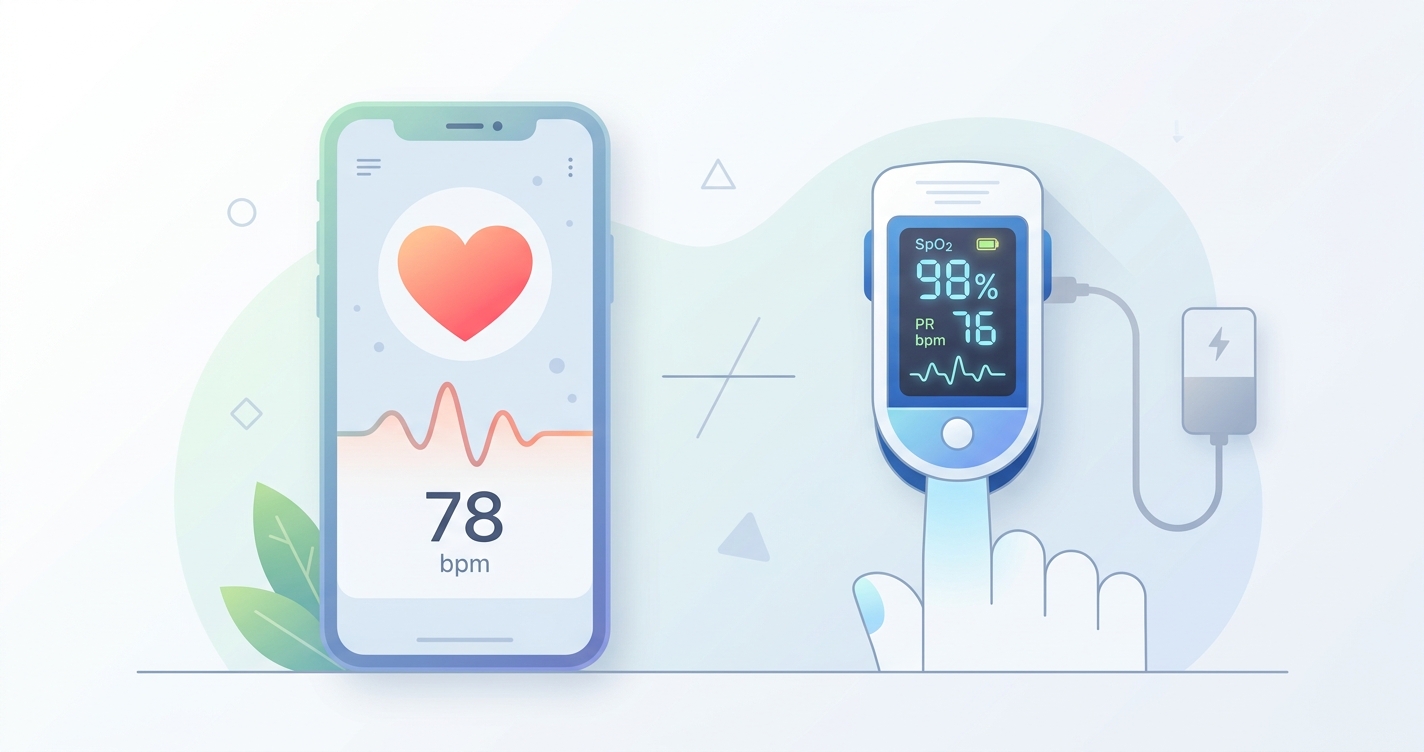
The drive to integrate health metrics into consumer and clinical applications has pushed developers to seek new methods for vital sign measurement. Traditional hardware like the finger-clip pulse oximeter is a familiar standard for point-in-time measurements. However, the ubiquity of high-quality smartphone cameras has given rise to a new, more scalable method: remote photoplethysmography (rPPG). For engineering leaders and product teams, the central question is one of performance. A nuanced analysis of phone vitals accuracy vs pulse oximeter capabilities reveals that while not a direct replacement, camera-based scanning offers a powerful and scalable alternative for specific use cases, provided its limitations are understood and managed during integration.
"In controlled settings with minimal motion, heart rate measurements from rPPG have shown a mean absolute error of less than 3 beats per minute when compared against contact-based ECG sensors and pulse oximeters."
- Based on findings from multiple validation studies, including work by Wang et al. (2017) and Nowara et al. (2021)
Understanding the core technologies
The comparison between a phone scan and a finger clip is fundamentally a comparison of two different methods of photoplethysmography (PPG), the optical technique of measuring blood volume changes. A pulse oximeter uses transmissive PPG, while a phone scan uses remote PPG (rPPG).
-
Transmissive Pulse Oximetry (Finger Clip): These devices work by shining light (typically red and infrared LEDs) through a translucent part of the body, like a fingertip or earlobe. A photodetector on the other side measures the amount of light that passes through. The pulsating nature of arterial blood causes changes in light absorption, which is directly translated into a heart rate and, by comparing the absorption of the different light wavelengths, blood oxygen saturation (SpO2).
-
Remote Photoplethysmography (Phone Scan): An rPPG-enabled application uses a standard smartphone camera to record a short video of the user's face. The underlying algorithms analyze the video frames to detect minute, imperceptible changes in skin color caused by the pressure wave of blood moving through the vessels beneath. As blood perfuses the skin, its changing volume alters how light is reflected back to the camera. This signal can be processed to extract heart rate, heart rate variability, respiration rate, and even estimates of blood pressure.
The debate around phone vitals accuracy vs pulse oximeter performance is therefore a question of signal acquisition. The finger clip gets a clean, direct signal through tissue, while the phone camera captures a reflected, more noisy signal that requires sophisticated software to interpret.
Performance comparison: phone scan vs. finger clip
| Feature | rPPG (Phone Vitals Scan) | Transmissive PPG (Pulse Oximeter) |
|---|---|---|
| Primary Technology | Remote Photoplethysmography (rPPG) | Transmissive Photoplethysmography |
| Required Hardware | Standard smartphone camera | Dedicated hardware with LEDs/photodiode |
| Key Metrics | Heart Rate, HRV, Respiration Rate, Blood Pressure (estimated) | Heart Rate, Blood Oxygen Saturation (SpO2) |
| User Experience | Contactless, video-based | Requires physical contact with finger/earlobe |
| Scalability | High (software-only deployment) | Low (requires hardware distribution) |
| Primary Limitation | Sensitive to motion, lighting, and skin tone | Requires physical access and proper placement |
| Ideal Use Case | Remote screening, wellness tracking, telehealth intake | Point-of-care checks, continuous monitoring in clinical settings |
Factors influencing phone vitals accuracy
For development teams integrating an rPPG SDK, understanding the factors that affect accuracy is critical for building a reliable user experience. Unlike a pulse oximeter, which controls its own light source, camera-based solutions are subject to environmental variables.
- Motion: Head movement is the primary source of noise. Algorithms must be able to distinguish between the cardiac signal and motion artifacts. Most SDKs require the user to remain still for the duration of the scan (typically 15-60 seconds).
- Lighting: Poor or fluctuating lighting conditions can compromise signal quality. While advanced algorithms can compensate for a wide range of environments, extremely low light or rapid changes in brightness present a challenge.
- Skin Tone: Early rPPG research was often conducted on a narrow range of skin tones. Validating performance across the full spectrum of the Fitzpatrick scale is a critical due-diligence step for any team licensing this technology. Researchers like Ofonedu et al. (2022) have highlighted the importance of diverse datasets in mitigating algorithmic bias.
- Camera Quality: While modern smartphone cameras are generally sufficient, older devices with lower-quality sensors may yield a weaker signal.
Industry applications for development teams
Product teams are not using rPPG to replace medical devices. They are using it to create entirely new workflows that were previously impossible due to the friction of hardware.
Wellness and fitness platforms
For apps focused on stress management, fitness, and general wellness, rPPG provides a frictionless way to measure metrics like Resting Heart Rate and Heart Rate Variability (HRV). Users can track trends over time without needing a separate wearable device, increasing engagement and retention.
Telehealth and triage
In a virtual care setting, a pre-appointment vitals scan can provide a valuable baseline for the clinician. While not used for diagnosis, it can help triage patients and offer objective data points alongside patient-reported symptoms. This is a powerful application that enhances the efficiency of virtual consultations.
Digital insurance and underwriting
Insurtech platforms are increasingly using camera-based vitals to streamline underwriting and wellness programs. Offering policyholders a way to complete a health screening from their phone reduces costs and improves the customer experience, replacing the need for in-person paramedical exams for certain policies.
Current research and evidence
The scientific foundation for rPPG was established by researchers like Wim Verkruysse, Lars Svaasand, and J. Stuart Nelson in their 2007 paper, which first demonstrated that a webcam could extra a photoplethysmographic signal from video of the human face. Since then, research has accelerated. A 2021 study by an international team of researchers published in JMIR found that newer algorithmic approaches could achieve high accuracy for heart rate and a reasonable correlation for blood pressure estimation when compared to reference devices.
The primary focus of current research is on improving robustness to motion and expanding the range of measurable biomarkers. Signal processing techniques and deep learning models are at the forefront of this effort, enabling the extraction of a clearer cardiac signal from noisy video data. Validation remains a key theme, with a growing body of literature comparing rPPG measurements against the outputs of multi-parameter patient monitors used in clinical environments.
The future of contactless monitoring
The trajectory of rPPG technology is pointed toward greater accuracy and a wider range of applications. As smartphone camera technology continues to improve and algorithms become more sophisticated, the gap between what can be measured with a camera and what requires a dedicated contact device will narrow. The future likely involves sensor fusion - combining the camera signal with data from other sensors on a smartphone, such as the microphone or gyroscope, to produce an even more reliable and comprehensive picture of a user's physiological state.
For developers, this means the barrier to integrating powerful health metrics will continue to fall. The ability to deploy vital sign monitoring to any user with a smartphone, without shipping a single piece of hardware, represents a fundamental shift in how digital health services are designed and delivered.
Frequently asked questions
Is a phone vitals scan as accurate as a pulse oximeter? For heart rate, high-quality rPPG solutions can be very accurate, often within a few beats per minute of a pulse oximeter in controlled conditions. For other metrics like blood oxygen saturation (SpO2), transmissive pulse oximeters remain the standard. Phone-based solutions are generally intended for non-medical wellness screening, not for replacing clinical devices.
What factors most affect the accuracy of a phone camera scan? The most significant factors are user motion, ambient lighting conditions, and the distance/angle of the face from the camera. Modern rPPG SDKs use advanced signal processing to mitigate these factors, but they remain important considerations for user guidance within an app.
Can rPPG technology replace conventional medical devices? No. rPPG is a tool for screening, monitoring trends, and providing convenient baseline measurements in a non-clinical context. It is not a replacement for medical-grade equipment used for diagnosis or treatment monitoring in a hospital or clinical setting.
What is the main advantage of rPPG for a development team? The primary advantage is scalability. It allows a team to deploy vital sign monitoring capabilities to a massive user base through a software-only update to an existing application. This eliminates the significant logistical and cost barriers associated with distributing and managing physical hardware.
For engineering teams evaluating the integration of contactless vitals, understanding these validation nuances is the first step. Circadify provides developer-first tools and custom builds to accelerate this process. Explore our developer documentation and request a custom build to get started.