Why does my fitness tracker app suddenly want me to hold my phone still for a minute?
Why fitness apps now ask you to hold your phone still for a minute, and what stable video input means for accurate camera-based vital sign readings.
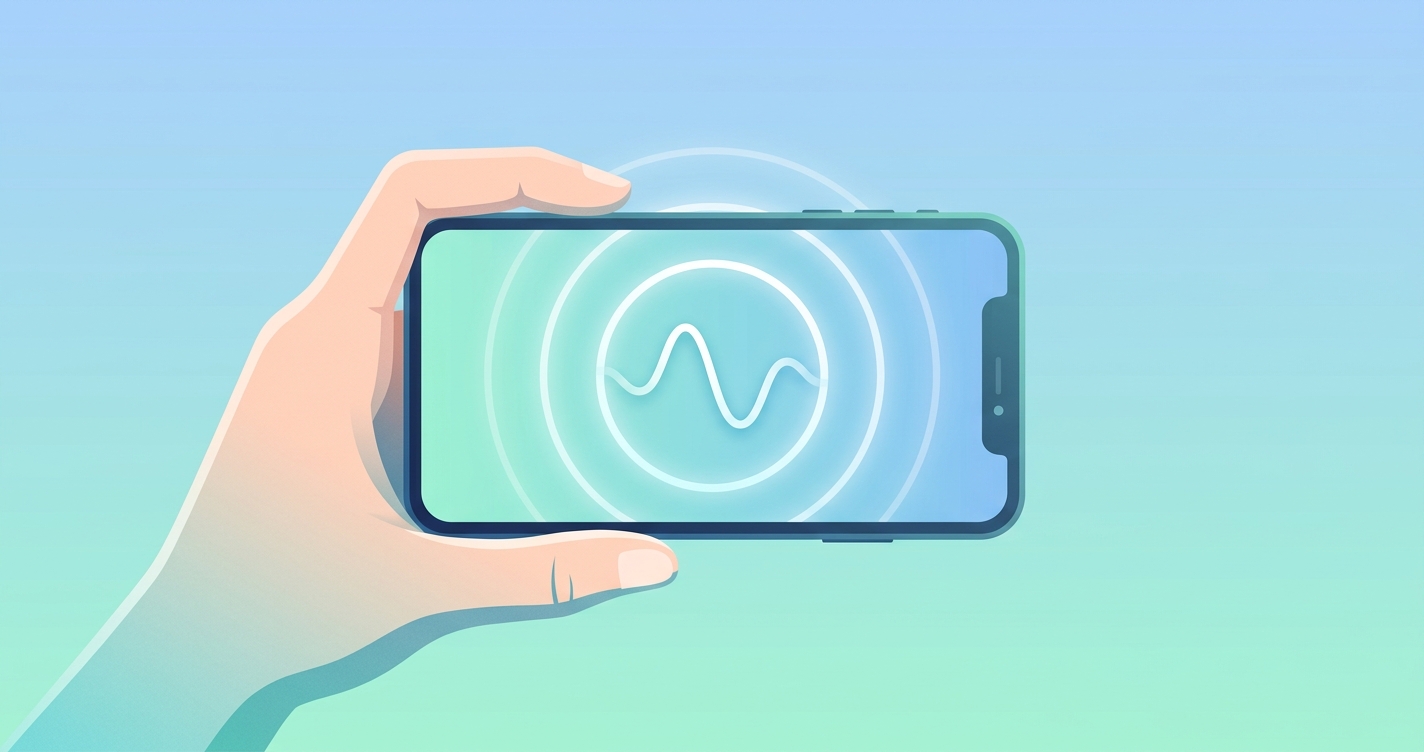
If your fitness tracking app recently started asking you to hold your phone still for a minute before it returns a heart rate or stress reading, that prompt is not arbitrary. It marks the moment the app stopped guessing at your pulse from accelerometer data and started measuring it directly from the camera. The reason a fitness app will ask you to hold your phone still comes down to a single technical reality: camera-based vital sign measurement extracts a signal that is thousands of times weaker than the visual noise motion introduces. For the development teams shipping these features, the still-hold prompt is the cheapest, most reliable lever they have for protecting measurement quality.
Motion artifacts are the primary obstacle to reliable remote photoplethysmography, degrading the signal-to-noise ratio of a pulse waveform that already represents skin color changes of less than 1 percent. A 2024 review in the journal Electronics catalogued motion compensation as the single most active research problem in the field.
Why a fitness app asks you to hold your phone still
The technology behind these readings is remote photoplethysmography, or rPPG. A standard RGB camera detects tiny color fluctuations in skin caused by blood volume changes with each heartbeat. As researchers reviewing the field have noted, the two defining challenges are limited signal strength and motion artifacts. The blood volume pulse signal sits at roughly 0.5 to 1 percent of the total pixel intensity. Any movement of the phone, the hand, or the face shifts the region of interest across pixels, and that displacement produces intensity changes far larger than the pulse itself.
When a fitness app asks you to hold your phone still, it is widening the gap between signal and noise. A stable frame keeps the tracked facial or fingertip region anchored to the same pixels across the full capture window, so the algorithm separates the periodic cardiac signal from the background. Move the phone, and the dominant frequency the algorithm locks onto may be your hand tremor at 4 to 8 Hz rather than your pulse at roughly 1 to 2 Hz.
The one-minute window is also not random. rPPG pipelines typically need 20 to 60 seconds of clean frames to build a stable frequency estimate. Frequency-domain methods rely on enough cardiac cycles to produce a sharp peak in the power spectrum. Shorter windows widen the peak and increase error, especially for breathing rate and heart rate variability, which need more cycles than a simple pulse count.
| Capture condition | Effective signal-to-noise ratio | Typical heart rate error | Developer impact |
|---|---|---|---|
| Phone handheld, walking | Very low | Often unusable | High failure rate, support tickets |
| Phone handheld, no guidance | Low to moderate | Elevated, inconsistent | Silent accuracy degradation |
| Phone held still, 30-60s window | High | Low, single digits BPM | Reliable readings, fewer retries |
| Phone braced or docked | Highest | Lowest | Best case, rarely achievable in field |
The practical takeaway for product teams is that user guidance is part of the measurement system, not a cosmetic layer on top of it.
What stable video input actually requires
Stability is more than the absence of large motions. Several distinct factors feed into whether a capture session produces a usable waveform:
- Translational stability, meaning the region of interest stays on the same pixels frame to frame.
- Rotational stability, since tilting the phone changes lighting angles across the skin surface.
- Consistent illumination, because auto-exposure adjustments triggered by movement inject their own intensity drift.
- Stable frame rate, since dropped or uneven frames distort the time base the frequency analysis depends on.
- Focus lock, so the skin texture stays sharp and the color sampling stays consistent.
A still-hold prompt addresses most of these at once. Holding the phone steady reduces translation and rotation, lets auto-exposure settle, and keeps the subject inside the frame so the tracker does not lose the region of interest mid-capture.
Industry applications for fitness platform teams
Wellness and recovery scoring
Fitness platforms increasingly fold resting heart rate, heart rate variability, and breathing rate into recovery and readiness scores. These metrics are far more motion-sensitive than a simple beats-per-minute number. HRV in particular depends on accurate inter-beat interval timing, which collapses under motion artifacts. A deliberate still-hold flow is the difference between a recovery score users trust and one they quietly ignore.
Pre-workout and post-workout checks
Capturing vitals immediately after exertion is the hardest case in the field. The user is breathing heavily, possibly sweating, and elevated heart rates already reduce rPPG accuracy. Research has shown accuracy drops sharply at high heart rates, so the still-hold instruction matters most precisely when the reading is most valuable. Teams designing these flows should budget for a short stabilization countdown before capture begins.
SDK integration and UX handoff
For developer teams integrating a health monitoring SDK, the still-hold prompt is where the SDK contract meets the user interface. A well-built rPPG SDK surfaces real-time signal quality and motion confidence so the host app can coach the user in the moment rather than failing silently at the end. The prompt is the visible tip of a feedback loop that ideally runs every frame.
Current research and evidence
The research record is consistent on this point. A 2024 review titled "Remote Photoplethysmography: A Review of Motion Artifact Reduction Techniques," published in Electronics, frames motion compensation as the central open problem and surveys methods spanning independent component analysis, principal component analysis, and deep learning approaches that learn to suppress motion adaptively.
Work on smartphone-based measurement has quantified the gains from better artifact handling. A study on remote real-time heart rate monitoring using recursive motion artifact removal from a smartphone camera reported peak detection improvements above 37 percent in worst-case conditions, reaching a mean absolute error of roughly 3.6 BPM at a 0.4 meter distance. Two-stage motion artifact reduction algorithms applied to facial video have similarly shown that cleaning the signal after capture only goes so far. The cleaner the input, the lower the residual error, which is why guiding the user toward a stable capture remains the highest-use intervention.
Evaluations of measurement conditions for telemedicine applications reinforce the same hierarchy. Lighting matters, distance matters, but uncontrolled movement remains the dominant source of error in real-world use. No amount of post-processing fully recovers a signal that motion has buried.
The future of stable capture in fitness apps
The still-hold prompt is a transitional design pattern. As motion compensation algorithms mature, the tolerance for movement will widen, and capture windows will shrink. Several directions are already visible:
- Adaptive capture that ends as soon as enough clean frames are collected, rather than running a fixed timer.
- Real-time quality feedback that nudges the user only when motion crosses a threshold, reducing unnecessary retries.
- Sensor fusion that uses the phone's gyroscope and accelerometer to flag and discard motion-corrupted frames before they reach the rPPG pipeline.
- On-device deep learning models trained to separate cardiac signal from motion, lowering the bar for how still a user must hold the device.
For now, the one-minute still-hold remains the most dependable way to keep readings honest. It is a small ask of the user that protects the integrity of every metric downstream.
Frequently asked questions
Why does the app need a full minute instead of a few seconds?
rPPG pipelines need enough complete cardiac cycles to produce a sharp frequency estimate. A 20 to 60 second window gives the algorithm enough data to separate your pulse from noise, and longer windows are required for breathing rate and heart rate variability, which need more cycles than a single pulse count.
Will the reading fail if I move slightly?
Small movements are usually tolerated because the region-of-interest tracker compensates for minor drift. Sustained motion, walking, or large hand tremor is what pushes the signal-to-noise ratio below a usable threshold. Many SDKs monitor motion in real time and will prompt a retry rather than return a low-confidence number.
Is bracing my phone against something better than holding it?
Yes. Bracing or docking the phone produces the highest signal-to-noise ratio because it removes both translation and rotation. Holding it still by hand is the practical middle ground that most fitness apps optimize their guidance around.
Does this mean the camera is more accurate than my old tracker?
Camera-based measurement is direct optical sensing of blood volume changes rather than an estimate derived from motion sensors. Under stable conditions the accuracy is strong, which is exactly why the app insists on a still capture. The accuracy depends on giving the algorithm clean input.
Circadify is building developer tooling for exactly this problem, with a drop-in rPPG SDK that surfaces real-time motion and signal quality so your team can design capture flows that get reliable readings on the first try. Explore the developer docs and request API keys at circadify.com/custom-builds to see how contactless vitals fit into your fitness platform.