How Digital Health Startups Use the Circadify SDK
How digital health startups integrate the Circadify rPPG SDK to add contactless vital signs to telehealth, wellness, and chronic care apps without building measurement infrastructure from scratch.
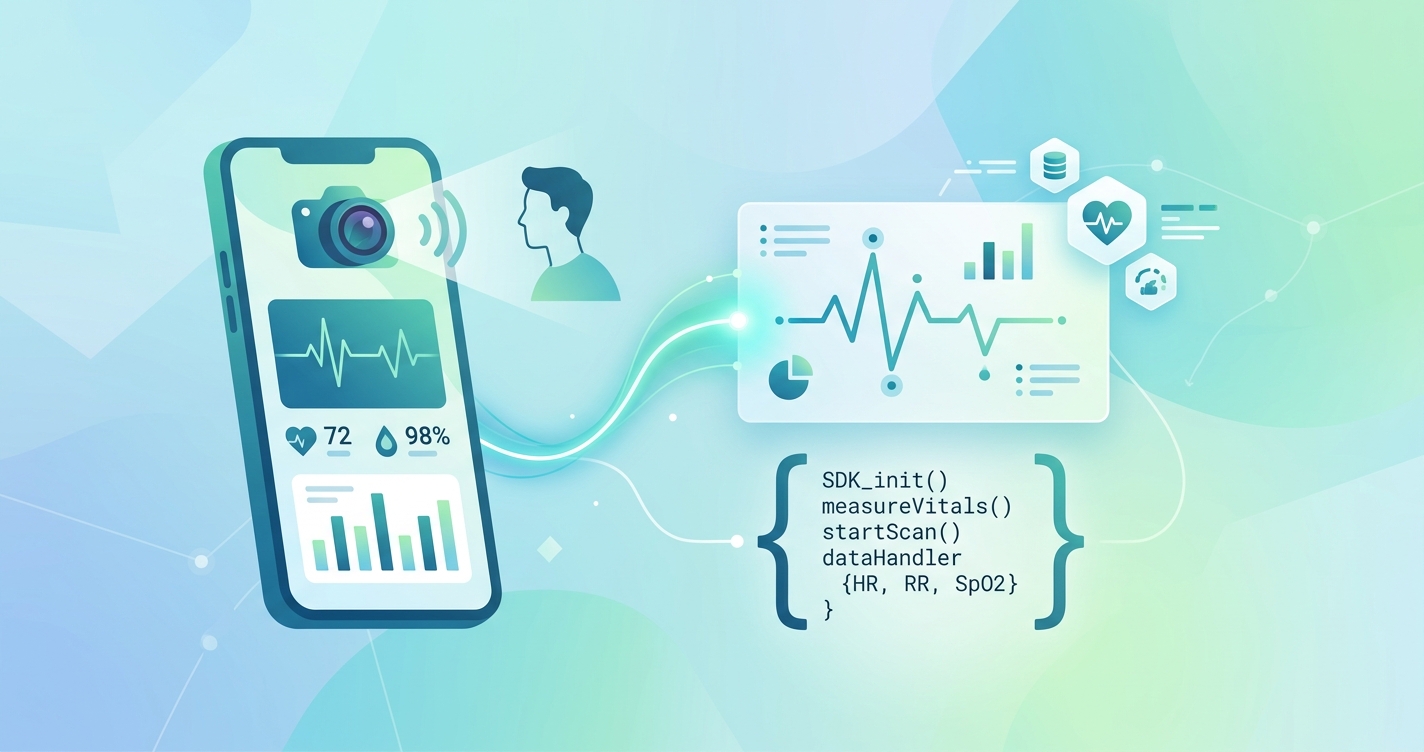
The digital health market hit $427 billion in 2025, according to Fortune Business Insights, with U.S. venture funding reaching $14.2 billion that same year per Rock Health's year-end analysis. A growing share of that capital flows into startups that don't build measurement hardware at all. They build platforms, workflows, and experiences on top of existing biometric infrastructure. The digital health startup Circadify SDK use case pattern reflects this shift: founding teams embedding contactless vital sign capture into their products through third-party SDKs rather than spending 18 months and seven figures developing proprietary signal processing.
"81.4% of the rPPG research bibliography was published between 2015 and 2025, reflecting a rapid acceleration in both academic interest and commercial viability of camera-based physiological measurement." — Frontiers in Digital Health, 2025 systematic review
Why startups are choosing SDK integration over building in-house
The calculus is straightforward when you break it down. Remote photoplethysmography requires expertise in computer vision, signal processing, and physiological modeling. Building an rPPG engine from scratch means hiring specialists in all three domains, training models on diverse skin tones and lighting conditions, running validation studies, and maintaining the pipeline across iOS and Android updates. For a Series A startup with 12 engineers, that's not a reasonable allocation.
The alternative: integrate a tested SDK and focus engineering effort on the product layer that actually differentiates the company. As we covered in our rPPG SDK getting started guide, the integration process is designed for small teams moving fast. A telehealth startup's competitive advantage is rarely its ability to extract a pulse signal from a video feed. It's the clinical workflow, the patient experience, the EHR integration, or the care coordination model built around that data.
Dr. Daniel McDuff, formerly of Microsoft Research and now at Google, published extensively on camera-based physiological sensing. His 2023 work with Xin Liu at the University of Washington demonstrated that pre-trained rPPG models could generalize across diverse populations when properly validated, which is the kind of foundational research that startup teams would need to replicate or license if building from scratch. Most choose to license.
Time and cost comparison: build vs. integrate
| Factor | Build in-house | SDK integration |
|---|---|---|
| Time to first measurement | 8-14 months | 1-4 weeks |
| Engineering headcount needed | 6-10 specialists | 1-2 generalists |
| Estimated first-year cost | $1.2M-$2.5M | $50K-$200K (licensing) |
| Cross-platform support | Built separately per OS | Included |
| Ongoing model maintenance | Internal team | SDK provider |
| Validation data collection | Required internally | Provider-managed |
| Regulatory documentation support | Self-managed | Shared responsibility |
The numbers vary by startup stage and ambition, but the ratio holds. A 2024 analysis in IEEE Software Engineering Economics found that maintenance costs for health platform integrations exceeded initial development costs by 3.2x over five years. That multiplier hits harder when the integration is a custom-built measurement engine rather than a managed SDK.
How startups actually deploy the SDK
Three deployment patterns have emerged across the digital health startup ecosystem. Each maps to a different product strategy and a different relationship with the measurement layer.
Telehealth platforms adding vitals to video visits
This is the most common pattern. A telehealth startup already has video infrastructure. Adding vital sign capture during the video visit turns a convenience tool into a clinical data source. The Circadify SDK processes the same camera feed the patient is already using for their video call, extracting heart rate, respiratory rate, HRV, blood pressure estimates, and SpO2 without asking the patient to do anything differently.
The clinical value here is real. A 2024 study published in the Journal of Medical Internet Research by researchers at Cedars-Sinai found that telehealth visits with integrated vital sign data led to 23% fewer follow-up in-person visits, because clinicians had enough data to make care decisions remotely. The study used wearable-sourced vitals, but the same clinical workflow applies to camera-sourced measurements with the advantage of zero patient setup.
Wellness apps building engagement through daily scans
Consumer wellness startups face a retention problem. The average health app loses 80% of users within three months, according to a 2024 IQVIA Digital Health Trends report. Daily vital sign scanning creates a lightweight engagement loop: open the app, scan your face for 30 seconds, see your numbers. It's the kind of low-friction habit that keeps users coming back.
These startups typically use the SDK's pre-built UI components for the scanning experience and customize the results display to match their brand. The measurement itself is a means to an end. The real product is the trend analysis, the coaching, the community features built on top of the vitals data.
Chronic care management platforms replacing hardware
Chronic care management (CCM) companies bill Medicare for remote monitoring of patients with conditions like heart failure, COPD, and diabetes. Historically, this required shipping patients a blood pressure cuff, a pulse oximeter, and sometimes a weight scale. The logistics are expensive, patients lose the devices, and compliance drops over time.
A growing number of CCM startups are exploring camera-based measurement as a supplement or alternative to shipped hardware. The patient already has a smartphone. If the phone camera can capture the relevant vitals, the startup eliminates a major operational cost center and improves compliance by removing friction.
Technical integration patterns
The SDK supports multiple integration depths. Where a startup lands on this spectrum depends on how much control they need over the measurement experience. We explored this trade-off in depth in our white-label vs API integration analysis.
| Integration level | What the startup controls | What the SDK handles | Typical startup stage |
|---|---|---|---|
| White-label drop-in | Branding and colors | Everything else | Pre-seed to Seed |
| UI components with customization | Layout, flow, results display | Camera management, signal processing | Seed to Series A |
| Headless SDK | Full UI, data pipeline, UX | Signal extraction and processing | Series A and later |
| Raw API | Everything client-side | Server-side processing only | Series B+ with dedicated team |
Early-stage startups almost always start with the component-based approach. It's fast to ship and the pre-built screens handle the tricky parts: camera permissions, lighting guidance, face positioning, and motion artifacts. As the product matures and the team grows, startups progressively replace individual components with custom implementations. This migration path avoids the expensive mistake of over-building at the seed stage.
Platform considerations
iOS and Android have different camera APIs, different permission models, and different processing characteristics. The SDK abstracts these differences, but startups still make platform-specific decisions about where to run inference. On-device processing keeps data local, which simplifies privacy compliance but requires more computational resources. Server-side processing reduces client-side requirements but introduces latency and data transmission considerations.
Most telehealth startups opt for on-device processing because their users are already in a real-time video context where latency matters. Wellness apps are more flexible since a 30-second scan doesn't require real-time feedback on every frame.
Current research backing camera-based vitals
The academic foundation for rPPG continues to grow. A comprehensive 2025 review in Frontiers in Digital Health surveyed the field and found that rPPG research output has accelerated dramatically, with over four-fifths of the relevant literature published in the last decade.
Key research milestones that matter for startup founders:
-
Heart rate accuracy: Multiple independent studies have demonstrated that camera-based heart rate measurement can achieve correlation coefficients above 0.95 with contact-based reference devices under controlled conditions. Researchers at ETH Zurich and the University of Oulu have published extensively on robustness improvements.
-
Respiratory rate extraction: Work by Gerard de Haan at Philips Research and subsequent studies have shown that breathing-induced intensity variations in facial video can be isolated from cardiac signals, enabling simultaneous measurement of both vital signs from a single camera feed.
-
Blood pressure estimation: This remains the most active research frontier. A 2024 paper by Rong and colleagues at Tsinghua University demonstrated pulse transit time estimation from facial video, though the field acknowledges that camera-based BP measurement is earlier in its validation journey than heart rate or respiratory rate.
-
Skin tone and lighting robustness: The DeepPhys architecture proposed by Chen and McDuff (2018) and subsequent transformer-based approaches have progressively improved performance across diverse skin tones and ambient lighting conditions, addressing what was historically the technology's most significant limitation.
The future of SDK-first health startups
The pattern of building on top of measurement SDKs rather than building measurement infrastructure mirrors what happened in payments (Stripe), communications (Twilio), and mapping (Mapbox). The infrastructure becomes a commodity. The value moves to the application layer.
For digital health startups, this means the founding team's background matters less in signal processing and more in clinical workflow design, patient engagement, and regulatory strategy. The teams that win are the ones who understand their end users deeply, not the ones who can write the best Fourier transform implementation.
Rock Health's 2025 funding data shows this playing out: provider-led, workflow-driven solutions attracted the largest share of investment. The measurement layer is necessary but not sufficient. What you build on top of it determines whether the product actually gets used.
Frequently asked questions
How long does it take a startup to integrate the Circadify SDK?
Most teams get a working prototype within one to two weeks. Production deployment, including testing across device types and edge cases, typically takes three to six weeks depending on how much custom UI work the team wants to do.
Does using an SDK limit a startup's ability to differentiate?
No. The SDK handles signal extraction and processing. The startup controls the entire user experience, data pipeline, clinical workflow, and business logic. Two startups using the same measurement SDK can build completely different products, the same way two companies using Stripe build completely different commerce experiences.
What about data privacy when using a third-party SDK?
The SDK processes video frames on-device and extracts numerical vital sign values. Raw video data doesn't leave the device in on-device processing mode. Startups retain control of the extracted data and can architect their privacy model around the numerical outputs rather than raw biometric video.
Can a startup switch from SDK to in-house later?
Yes, but most don't. The ongoing maintenance cost of an in-house rPPG engine, including model updates, device compatibility testing, and validation work, typically exceeds the SDK licensing cost. Startups that do transition in-house usually wait until they've raised Series C or later and have a specific technical need the SDK can't accommodate.
The SDK-first approach to health measurement is becoming the default for digital health startups that want to move quickly without sacrificing measurement quality. Platforms like Circadify provide the rPPG infrastructure layer, letting startup teams focus their energy on the product decisions that actually determine whether patients and clinicians adopt the tool.