How do developers add contactless vital signs without a medical background?
A technical guide for non-medical developers on how to integrate contactless vital signs using an SDK, with a focus on rPPG technology and its applications.
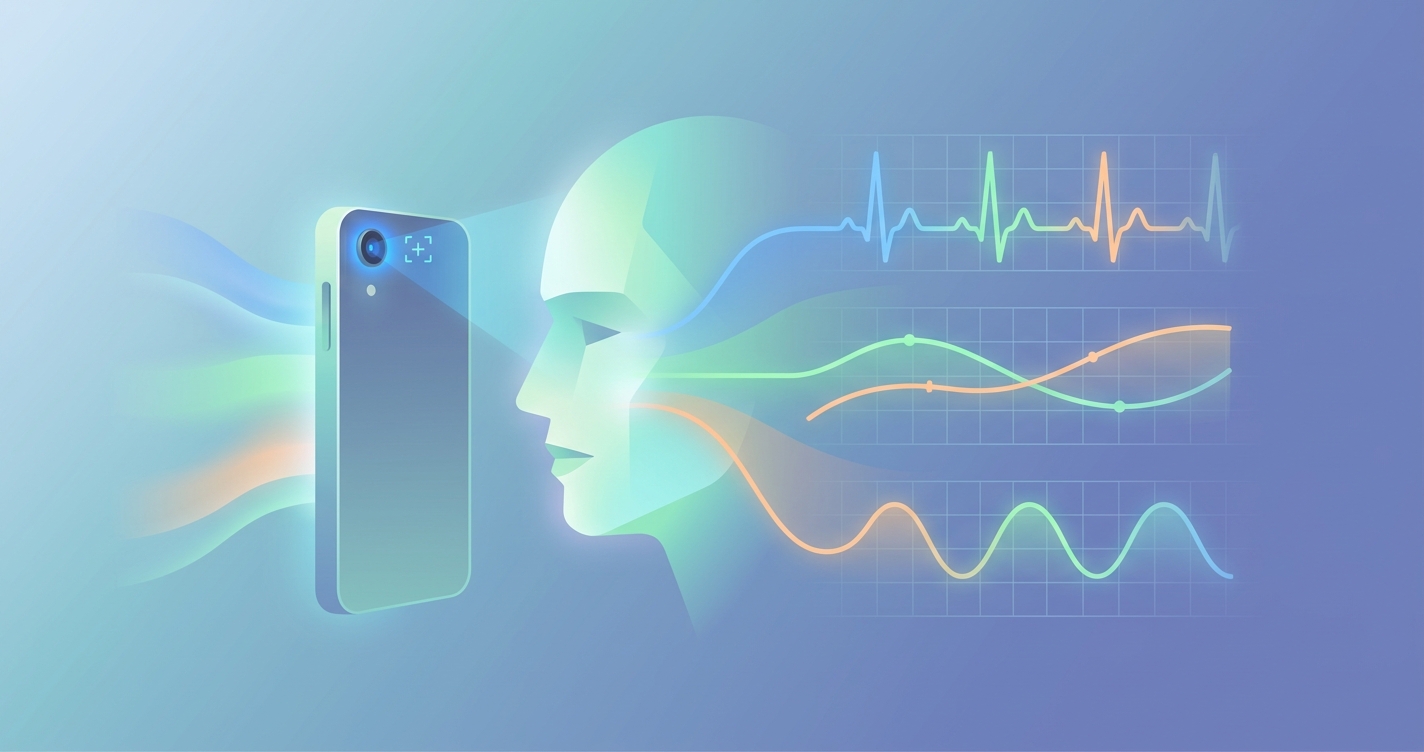
The demand for integrated health features within consumer applications is accelerating. From wellness and fitness to insurance and telehealth, users expect digital experiences that provide personalized health insights. This creates a significant opportunity for developers, but also a substantial challenge: how can a developer with a background in software engineering, but not in medicine or biomedical signal processing, build these features? The task of translating raw camera data into physiological measurements is a highly specialized field at the intersection of computer vision, signal processing, and human physiology.
"The global remote patient monitoring market is projected to reach $175.2 billion by 2028, a significant portion of which is driven by software-based solutions that can be integrated into existing applications."
The Role of the Contactless Vitals SDK for the Non-Medical Developer
For developers without a specialization in life sciences, the most direct path to implementing these features is through a Software Development Kit (SDK). A contactless vitals SDK non-medical developer can use is essentially a pre-packaged module of code that handles the immense complexity of remote photoplethysmography (rPPG). rPPG is the core technology that uses a standard camera, like the one in a smartphone or laptop, to detect subtle, imperceptible changes in the color of a person's skin. These changes correspond to the pressure wave of blood flowing through the circulatory system.
An SDK provides a high-level API that abstracts away the underlying complexity. Instead of needing to build and train machine learning models, contend with signal noise from motion or lighting changes, and translate processed signals into vital signs, the developer can make a few simple API calls. The SDK handles the heavy lifting:
- Data Acquisition: Securely accessing the camera feed.
- Signal Processing: Isolating the minute color changes from the video stream.
- Noise Reduction: Applying algorithms to filter out interference from user movement or variable lighting.
- Physiological Calculation: Converting the clean signal into understandable metrics like heart rate, heart rate variability, and respiratory rate.
This abstraction layer is what makes it possible for a small development team or even an individual developer to add sophisticated health monitoring capabilities to an application in a matter of days, a task that would otherwise require a dedicated team of research scientists and months or years of work.
SDK feature comparison for developers
When evaluating a contactless vitals SDK, technical teams need to consider several architectural and functional aspects. The choice between different implementations can have significant implications for user experience, data privacy, and infrastructure costs.
| Feature | Option A: On-Device Processing | Option B: Cloud-Based Processing | Analysis |
|---|---|---|---|
| Data Privacy | Video data is processed locally on the user's device and never leaves it. | Video frames are sent to a cloud server for analysis. | On-device processing offers superior data privacy, a critical concern for health data. |
| Latency | Near-instantaneous results as there is no network round-trip. | Latency is subject to network conditions and server load. | For real-time feedback applications, on-device processing is generally faster. |
| Scalability | Scaling is distributed across user devices, reducing server-side costs. | Requires significant cloud infrastructure that scales with user growth. | On-device is more cost-effective at scale from an infrastructure perspective. |
| Model Updates | Requires shipping an app update to deploy new algorithms or models. | Models can be updated on the server-side instantly for all users. | Cloud-based processing allows for more rapid iteration and improvement. |
| Device Performance | Consumes CPU/GPU resources on the user's device, which can impact battery life. | Minimal impact on the user's device performance. | A key trade-off; on-device SDKs must be highly optimized for performance. |
Industry Applications
The ability to integrate vital signs monitoring easily has unlocked a wide range of use cases across multiple industries, driven by development teams who are not medical experts.
Wellness and fitness apps
Developers are adding features that allow users to check their heart rate before a workout or measure their stress levels (via Heart Rate Variability) after a meditation session. This provides a biofeedback loop that can increase user engagement and retention.
Telehealth Platforms
Integrating contactless measurements into a telehealth platform enables providers to gather objective data during a virtual consultation. A developer can use an SDK to embed this functionality directly into the video conferencing experience, allowing a clinician to request a scan without the patient needing a separate device.
Insurtech and digital underwriting
Insurers are exploring ways to use vital signs data to streamline underwriting and wellness programs. A developer for an insurance company could use a contactless vitals SDK non-medical developer tool to build a feature into their mobile app that allows applicants to complete a health assessment remotely, potentially leading to faster policy issuance and more personalized wellness incentives.
Current research and evidence
The field of rPPG is an active area of academic and commercial research. While the core principles are well-established, ongoing work aims to improve the accuracy, robustness, and range of measurable biomarkers. A 2023 review by researchers M. Z. Uddin, A. T. Asyhari, and M. A. F. M. Sani highlighted the increasing use of deep learning models to improve signal extraction and overcome traditional challenges like motion artifacts and variations in skin tone.
Key areas of research include:
- Motion Artifact Resilience: Developing algorithms that can maintain a strong signal even when the user is not perfectly still.
- Performance Under Low Light: Enhancing the signal-to-noise ratio in suboptimal lighting conditions.
- Expanding Biomarkers: Research is underway to reliably measure additional metrics like blood pressure, blood oxygen saturation, and glucose levels via rPPG, though these are still largely in the experimental phase.
- AI and Model Generalization: Researchers are using advanced AI techniques to create models that perform accurately across a diverse population with different skin types, ages, and health conditions.
This body of research is continuously integrated into commercial SDKs, allowing developers to benefit from current advancements without needing to become rPPG researchers themselves.
The future of contactless vitals sdks
The trajectory of contactless vitals technology points towards greater accessibility and more powerful capabilities. For developers, this means the tools they use will become even simpler and more potent. We can expect to see SDKs that offer a wider range of validated biomarkers, provide deeper levels of personalization, and are even more optimized for low-end devices and challenging real-world conditions. The distinction between a "health app" and a "general app" will continue to blur as developers of all backgrounds are empowered to build responsible, insightful health features into their products.
Frequently asked questions
Q: Do I need a medical or scientific background to use a contactless vitals SDK? A: No. The primary purpose of a contactless vitals SDK is to abstract the complex science and signal processing. A competent software developer should be able to integrate the SDK into their application using the provided documentation and API, without needing a background in medicine or physiology.
Q: What are the typical vital signs a non-medical developer can integrate? A: The most common and well-established metrics available through rPPG SDKs are Heart Rate, Heart Rate Variability (HRV), and Respiratory Rate. Some SDKs may offer other measurements, but these three are the foundational metrics for most wellness applications.
Q: How does a developer handle the accuracy of the measurements? A: The SDK provider is responsible for the accuracy and validation of the underlying algorithms. When selecting an SDK, developers should look for providers who are transparent about their validation methods and performance metrics. However, developers are responsible for implementing the SDK correctly according to the provided guidelines to ensure optimal performance.
The tools and technologies to bridge the gap between software development and health monitoring are rapidly maturing. For engineering leaders and their teams, the question is no longer whether it's possible to add contactless vital signs to an application, but how to best use these powerful new tools to create value for users. Circadify is actively working in this space to provide developers with the tools they need to build the next generation of health-aware applications. To learn more about our developer tools and start building, explore our resources at circadify.com/custom-builds.