How can an app see my breathing rate from across the room without touching me?
How a contactless breathing app reads respiration rate from camera, radar, and WiFi signals, the science behind it, and what developer teams need to know.
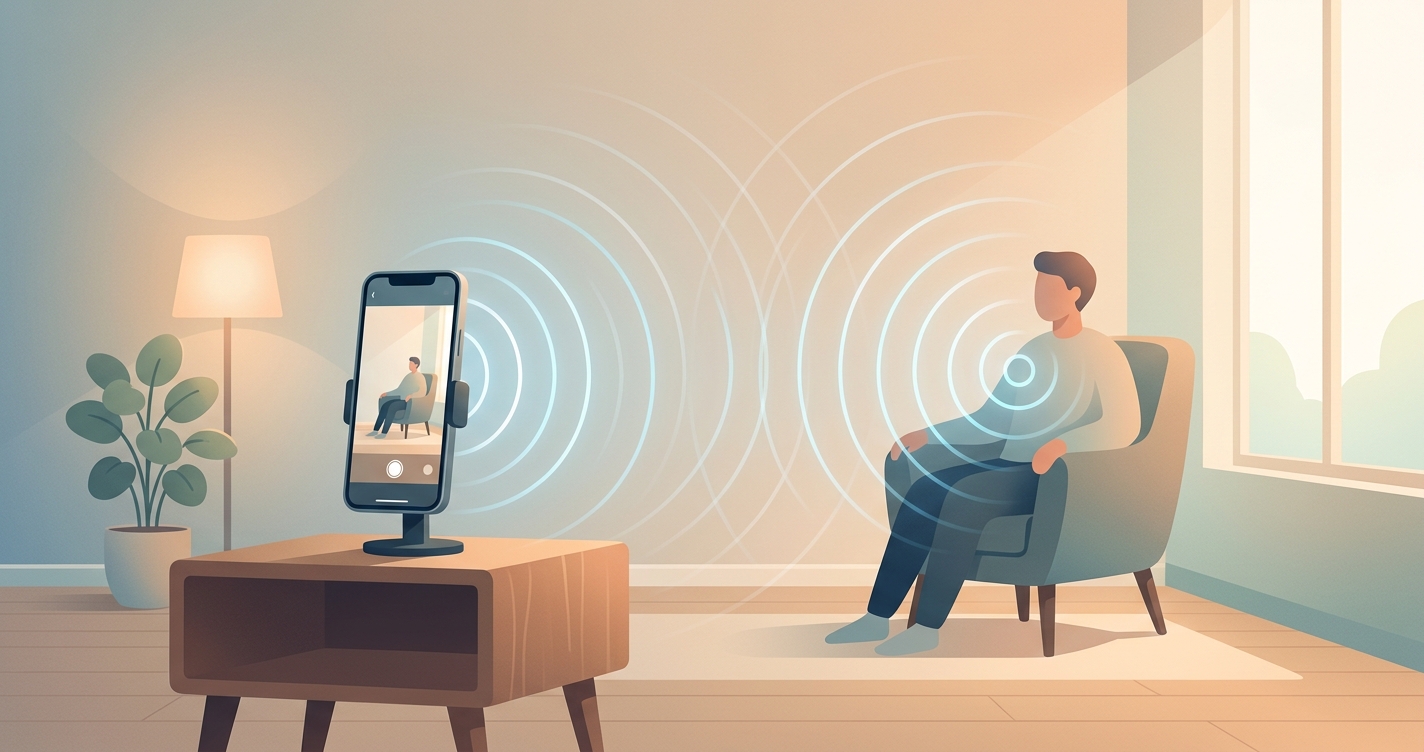
A camera pointed at a person from a few meters away holds more clinical information than most product teams realize. The same RGB sensor that captures a selfie or a video call records tiny periodic changes in skin color and chest motion that track the cardiac and respiratory cycles. A contactless breathing app turns those signals into a respiration rate without a chest strap, a nasal cannula, or any physical contact at all. For engineering teams evaluating health features, the question is no longer whether this works, but how reliably it works, what hardware it needs, and how hard it is to build into an existing product.
A camera-based method published on arXiv reported an average mean absolute error of 0.57 respirations per minute for breath rate measurement, a margin tight enough to rival contact sensors in controlled conditions.
How a contactless breathing app actually detects respiration
Breathing leaves two distinct fingerprints that a camera can read. The first is motion. When a person inhales, the chest and shoulders rise by a few millimeters, and the torso expands. A computer vision pipeline tracks these displacements frame by frame, isolates the periodic component that matches a plausible breathing frequency, and converts the dominant frequency into breaths per minute. Normal adult respiration sits between 12 and 20 breaths per minute, so the algorithm searches a narrow band roughly 0.2 to 0.5 Hz and rejects noise outside it.
The second fingerprint is subtler and comes from remote photoplethysmography, or rPPG. Each heartbeat pushes a pulse of blood into the capillaries near the skin surface, changing how much light the skin absorbs. A camera detects these changes as minute fluctuations in the green channel of facial pixels. Breathing modulates that pulse signal too, because respiration alters heart rate and blood volume in a regular pattern called respiratory sinus arrhythmia. By extracting the breathing-induced modulation from the rPPG waveform, a contactless breathing app can estimate respiration rate even when chest motion is hard to see.
The most robust systems combine both. A 2024 study from Samsung Research described a multimodal approach that fuses facial motion tracking with rPPG from a single RGB camera to estimate breathing rate, and reported high accuracy even while the subject moved. Fusing two independent signals is what lets a contactless breathing app stay stable when one channel degrades, for example when a user turns their head or the lighting shifts.
The signal processing chain, step by step
- Detect and track a region of interest, usually the face for rPPG and the chest or shoulders for motion.
- Sample the average pixel intensity per channel over time to build a raw waveform.
- Filter the waveform to the respiratory band and remove drift caused by ambient light and slow movement.
- Apply frequency analysis or a learned model to find the dominant breathing frequency.
- Convert that frequency to breaths per minute and apply confidence scoring.
Comparing contactless breathing measurement methods
Cameras are not the only way to sense breathing without contact. Radar and WiFi-based sensing read chest motion through electromagnetic reflections rather than light. Each modality carries different tradeoffs for accuracy, range, privacy, and integration cost. The table below summarizes reported performance from recent peer-reviewed work.
| Method | Reported accuracy | Typical range | Works in the dark | Integration cost for app teams |
|---|---|---|---|---|
| RGB camera (rPPG + motion) | MAE ~0.57 breaths/min (arXiv, 2023) | 0.3 to 3 m | No, needs ambient light | Low, uses existing camera and an SDK |
| FMCW radar | RMSE 0.39 to 1.09 breaths/min (MDPI, 2024) | 1 to 5 m | Yes | High, needs dedicated radar hardware |
| Ultra-wideband radar | ~1.11 breaths/min average deviation during motion (arXiv) | 1 to 3 m | Yes | High, specialized sensor |
| WiFi channel state information | ~91% detection accuracy (Wi-Breath, IEEE) | Whole room | Yes | Medium, needs CSI-capable radios |
For software teams building on phones, tablets, and laptops, the camera path is the only one that requires no new hardware. The sensor is already in the device, already permissioned for video, and already supported across platforms. That is why a contactless breathing app built on rPPG can ship as a pure software update while radar and WiFi approaches stay confined to fixed installations and research labs.
Industry applications for camera-based breathing detection
Telehealth and remote monitoring
During a video consultation, a clinician already has a live camera feed of the patient. Adding respiration rate to that feed gives an objective vital sign without shipping a device to the patient's home. Camera-based continuous heart and respiration monitoring has been validated in the ICU in published work, which suggests the signal quality is sufficient for structured environments where the subject is relatively still.
Sleep and aging-in-place
A JMIR mHealth and uHealth evaluation study tested contactless monitoring of heart rate, breathing rate, and breathing disturbance during sleep in older adults, framing it as an unintrusive alternative to wearables. For aging-in-place platforms, a camera or radar node in the bedroom can flag respiratory irregularities overnight without asking an elderly user to wear or charge anything.
Fitness and wellness
Respiration rate is a useful recovery and stress signal. A wellness app can capture a 30 to 60 second reading before or after a workout using the front camera, turning a passive moment into a data point. This is where a contactless breathing app reaches the largest audience, because no clinical setting or extra device is involved.
Neonatal and pediatric care
A study in the Journal of Biomedical Photonics and Engineering used a digital camera and deep learning for automated region of interest selection in newborns, reporting a mean absolute error of 1.11 breaths per minute from the face and 1.03 from the chest. Contactless sensing is especially valuable for fragile patients where adhesive sensors can damage skin.
Current research and evidence
The published evidence has moved from proof of concept to quantified accuracy. The recurring theme across 2023 and 2024 work is robustness to motion, historically the weakest point of camera-based vitals. The arXiv work on a robust camera method reported a mean absolute error near 0.57 breaths per minute, and the Samsung Research multimodal study showed that fusing facial motion with rPPG preserves accuracy when the subject moves.
Several survey papers, including a comprehensive 2024 review in Sensors and Diagnostics from RSC Publishing and a systematic review in MDPI, agree on the core challenges that remain. Separating respiratory-induced motion from voluntary movement is difficult. Skin tone, ambient lighting, and camera quality all affect rPPG signal strength, and accuracy degrades at distance and in low light. Deep learning regression models, particularly convolutional neural networks, are increasingly used to handle these conditions, and some teams are deploying these models on edge devices to manage latency and power.
For a developer audience, the practical takeaway is that accuracy is now a function of pipeline quality and capture conditions, not a fundamental ceiling. Good region-of-interest detection, proper filtering, motion compensation, and confidence scoring separate a usable contactless breathing app from a noisy demo.
The future of contactless breathing detection
Three directions are visible in the research. The first is multimodal fusion as the default, combining rPPG, chest motion, and sometimes audio into one estimate so that no single failure mode breaks the reading. The second is on-device inference, pushing the model to the phone or local hardware to cut latency and keep raw video off the network, which matters for privacy and compliance. The third is multi-person sensing, with WiFi and radar work already estimating breathing for several people in a room at once.
For product teams, the trajectory points toward respiration rate becoming a routine field in any app that already has camera access, alongside heart rate. The hard engineering, signal extraction, motion handling, and model tuning, is increasingly handled by a software development kit rather than rebuilt per project.
Frequently asked questions
How far away can a contactless breathing app measure respiration?
Camera-based methods typically work from roughly 0.3 to 3 meters in adequate lighting, since the sensor needs enough resolution to see skin color changes and chest motion. Radar and WiFi approaches extend further, up to several meters or full-room coverage, but require dedicated hardware rather than a standard camera.
Does it need special hardware or just a normal camera?
A standard RGB camera in a phone, tablet, or laptop is enough for rPPG and motion-based respiration detection. That is the main advantage of the camera path for app developers. Radar and WiFi sensing offer benefits like working in darkness, but they need specialized sensors that most consumer devices do not have.
How accurate is camera-based breathing measurement?
Recent peer-reviewed studies report mean absolute errors around 0.5 to 1.1 breaths per minute in controlled conditions. Accuracy depends on lighting, subject motion, camera quality, and the strength of the signal processing pipeline, so real-world results vary with capture conditions.
Is the video stored or sent to a server?
That depends on the implementation. Modern architectures favor on-device processing, where the video is analyzed locally and only the numeric result, not the raw footage, leaves the device. Teams handling health data should confirm where inference runs and design for data minimization.
Circadify is addressing this space with a drop-in rPPG SDK that lets engineering teams add contactless vitals, including respiration rate, to an existing app in days rather than months. Explore the developer docs and request API keys at circadify.com/custom-builds.