Can a mobile SDK really measure vitals as well as a finger clip?
A detailed comparison of remote photoplethysmography (rPPG) via mobile SDK and traditional pulse oximetry, analyzing accuracy, technology, and use cases.
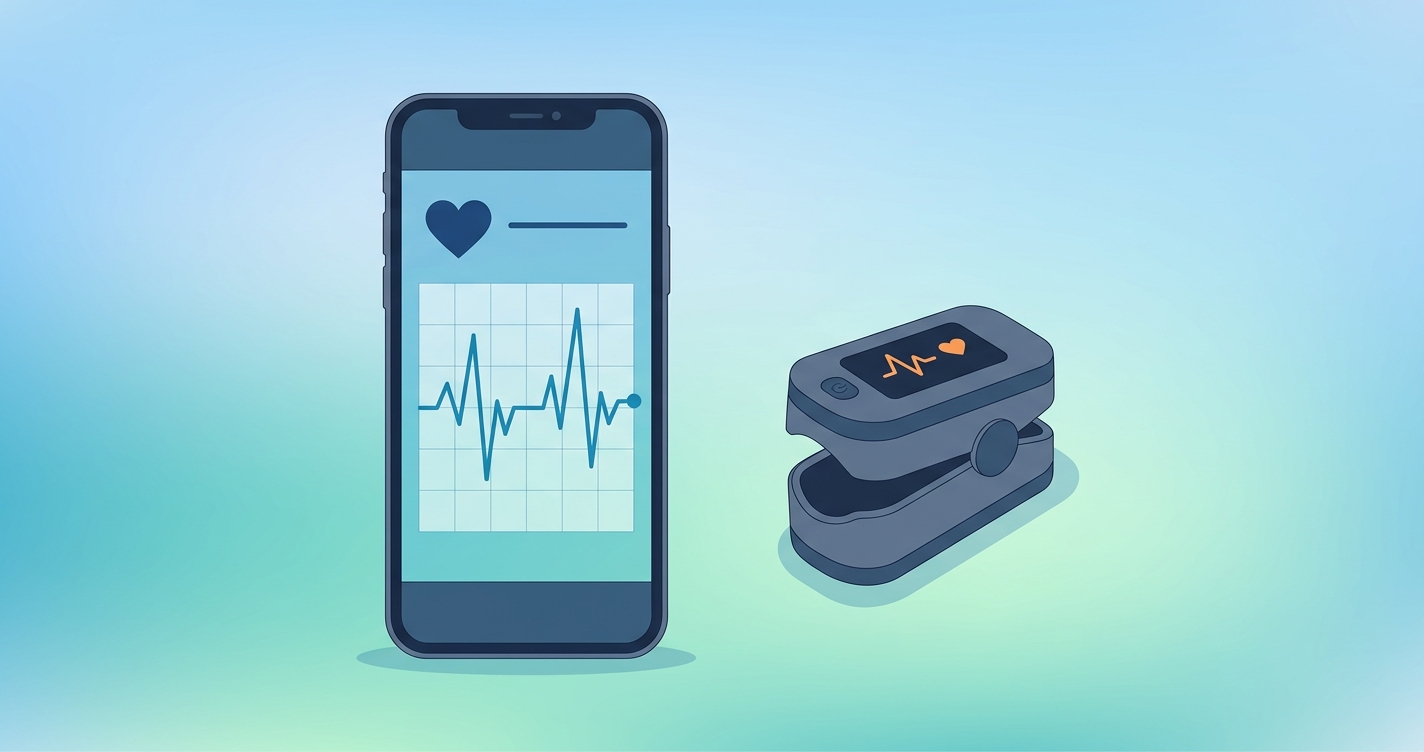
The drive to integrate health metrics into consumer and clinical applications has pushed developers to seek new methods for vital sign measurement. Traditionally, this required dedicated hardware like a finger-clip pulse oximeter. Today, mobile SDKs using remote photoplethysmography (rPPG) claim to measure vitals using only a smartphone camera. This raises a critical question for engineering teams: when it comes to mobile SDK vitals vs finger clip devices, how does the accuracy truly compare? The answer lies not in a simple "yes" or "no," but in the underlying technology, the use case, and a growing body of scientific evidence.
"A 2023 clinical validation study found rPPG-derived pulse rate to have strong agreement with ECG, with a mean absolute error of 1.061 bpm and a Pearson correlation of 0.962 in cardiovascular disease patients."
The Core Technology: rPPG vs. Transmissive PPG
The fundamental difference between a mobile SDK and a finger clip lies in how they apply photoplethysmography (PPG), a technique that measures changes in blood volume by shining light on the skin. A finger-clip oximeter uses transmissive PPG. It places a light source on one side of the fingertip and a detector on the other, measuring the light that passes through the tissue. As blood pulses through the arteries, the amount of absorbed light changes, allowing the device to calculate heart rate and oxygen saturation.
A mobile SDK, in contrast, uses remote PPG (rPPG). It repurposes the smartphone's camera and flashlight to analyze reflected light from the user's face. The camera records a short video, and sophisticated algorithms analyze the subtle, imperceptible changes in skin color caused by blood circulating underneath. These changes are then processed to extract vital signs like heart rate, respiratory rate, and blood pressure variability. This contactless method bypasses the need for any specialized hardware beyond the phone itself.
Comparison: Mobile SDK (rPPG) vs. Finger Clip (PPG)
| Feature | Mobile SDK (rPPG) | Finger Clip (Transmissive PPG) |
|---|---|---|
| Technology | Remote Photoplethysmography (rPPG) - analyzes reflected light from the skin via video. | Transmissive Photoplethysmography - measures light passing through tissue. |
| Hardware | Standard smartphone camera. | Dedicated hardware device. |
| Convenience | High - software-only solution, accessible to anyone with a smartphone. | Moderate - requires carrying and using a separate physical device. |
| Use Case | Telehealth, wellness apps, remote patient monitoring, insurance underwriting. | Clinical spot-checks, home monitoring for specific conditions. |
| Key Accuracy Factors | Lighting conditions, user movement, camera quality, skin tone, algorithm sophistication. | Probe positioning, user movement, poor circulation, skin pigmentation. |
| Scalability | Extremely high - can be deployed to millions of users via an app update. | Low to moderate - requires physical device distribution. |
Factors influencing accuracy
While both methods are effective, their accuracy can be influenced by several factors. Understanding these is key to evaluating the trade-offs between mobile SDK vitals vs finger clip measurements.
- Movement: Both technologies are sensitive to motion artifacts. A user moving during a finger-clip reading or a video-based rPPG scan can introduce noise and lead to inaccurate results. Advanced rPPG SDKs often incorporate algorithms to detect and compensate for head motion.
- Lighting: rPPG is highly dependent on stable, adequate lighting. Poor or fluctuating light can make it difficult for the camera's sensor to detect the subtle color changes in the skin. Finger-clip devices, being a closed system, are not affected by ambient light.
- Skin Tone: Historically, transmissive pulse oximeters have shown limitations in accuracy for individuals with darker skin tones, sometimes providing falsely high oxygen saturation readings. The FDA has acknowledged this issue and is working on new guidance (2023). rPPG technology is also affected by skin pigmentation, but developers can train algorithms on diverse datasets to mitigate this bias.
- Perfusion: The accuracy of a finger-clip device can be compromised by poor peripheral circulation (low perfusion), which can be caused by cold hands or certain medical conditions. Because rPPG typically uses the face, it is often less affected by peripheral perfusion issues.
Current research and evidence
Recent academic research provides a clearer picture of rPPG's performance. For heart rate, multiple studies have demonstrated that rPPG can achieve clinical-grade accuracy. A validation study published in 2023 involving cardiovascular disease patients showed a mean absolute error of just 1.06 bpm compared to the ECG gold standard. Researchers have consistently reported error rates within the ±2-5 BPM range in controlled settings.
Measuring oxygen saturation (SpO2) with rPPG is a more complex challenge and is considered less mature than heart rate measurement. However, progress is being made. A 2023 study directly comparing a novel ring-based rPPG oximeter with a traditional transmissive finger probe concluded that the rPPG method was comparable for detecting oxygen desaturation events.
It is also important to note the recognized limitations of consumer-grade finger-clip oximeters. Many non-medical devices available to consumers do not meet the International Organisation for Standardisation (ISO) accuracy standards required for FDA clearance, especially when true oxygen saturation falls below 90%. This context is crucial when comparing them to emerging mobile SDK solutions.
The future of contactless vitals
The trajectory for rPPG technology is one of rapid advancement, driven by improvements in three key areas:
- AI and Machine Learning: Deep learning models are becoming increasingly adept at filtering out noise from video feeds, improving signal extraction under non-ideal conditions like low light or user movement.
- Sensor Fusion: Future mobile health platforms will likely combine rPPG data with other sensor inputs, such as from the phone's accelerometer and microphone, to create a more holistic and accurate physiological profile.
- Expanded Biomarkers: Research is actively underway to expand the range of biomarkers that can be measured via the camera, including cuffless blood pressure, stress levels (via heart rate variability), and even blood glucose in the long term. As these models are refined, the capabilities of mobile SDKs will extend far beyond what current finger-clip devices can offer.
The debate over mobile SDK vitals vs finger clip accuracy is evolving. While finger-clip devices remain a standard for certain clinical spot-checks, they are no longer the only viable option. For large-scale, convenient, and accessible vital sign monitoring in a variety of settings from wellness to telehealth, mobile SDKs have proven to be a robust and increasingly accurate alternative.
Frequently asked questions
Q: Is rPPG as accurate as an ECG?
A: For heart rate, high-quality rPPG implementations have demonstrated strong agreement with ECGs, with studies showing a mean absolute error below 2 bpm in many cases. However, an ECG measures the heart's electrical activity and provides much more detailed diagnostic information. rPPG measures blood flow and is excellent for pulse rate but is not a substitute for a diagnostic ECG.
Q: Does a mobile SDK need regulatory clearance?
A: It depends on the intended use. If the SDK is marketed for general wellness purposes (e.g., tracking fitness, stress), it typically does not require FDA clearance. If it is intended for diagnosing or treating a disease, it is considered a medical device and would need to go through a regulatory approval process.
Q: How does a mobile vitals SDK handle user privacy?
A: Leading SDKs are designed with privacy as a priority. They typically perform all processing on the device itself, meaning the video stream of the user's face is analyzed locally in real-time and then discarded. Only the final numerical vitals data is returned to the application, and no images or videos are stored or transmitted.
Developing and integrating this technology in-house is a significant undertaking. For engineering teams at health platforms looking to add contactless vitals to their applications, Circadify offers a solution to accelerate this process from months to days. Explore our developer documentation and get API keys to start your build at circadify.com/custom-builds.