
Camera-Based Vitals vs Wearables for Health Platforms
A technical comparison of camera-based vitals vs wearables across accuracy, cost, user friction, and scale to guide monitoring architecture decisions.
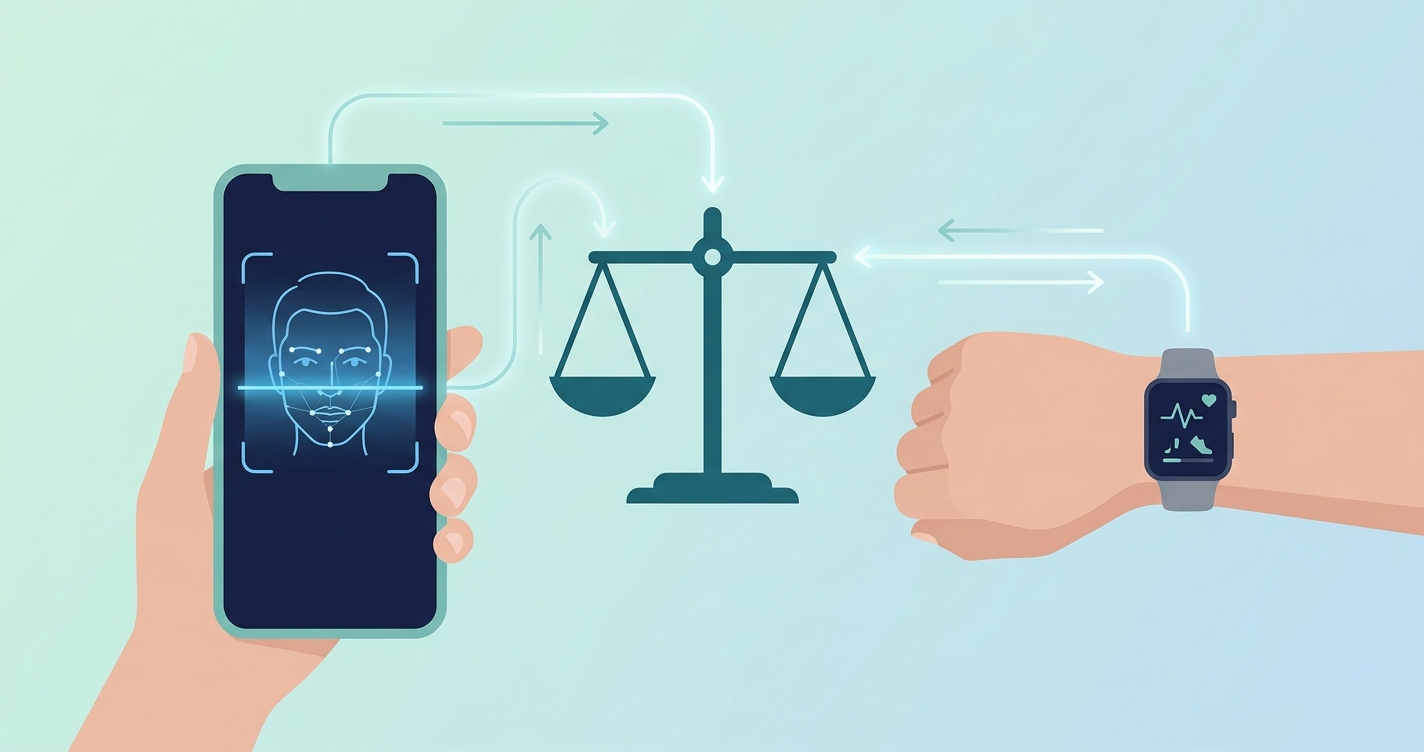
Engineering leaders building health platforms face an architectural fork that shapes everything downstream: do you measure vital signs through a camera the user already owns, or do you integrate a fleet of wearable devices and the SDKs that ship with them? The choice of camera-based vitals vs wearables touches accuracy budgets, hardware logistics, privacy posture, onboarding friction, and the unit economics of scaling to millions of users. It is rarely a pure accuracy question, and treating it as one leads teams to over-index on lab benchmarks while ignoring the variable that quietly kills most monitoring products: whether people keep using them.
"A third of consumers who purchased a smartwatch or fitness band abandoned the device within six months," reported Gartner analyst Angela McIntyre, a figure echoed across 2024 industry surveys showing roughly 30 percent abandonment and as many as 79 percent of buyers with at least one unused tracker at home.
That single statistic reframes the comparison. A wearable that is accurate on the wrist is worthless in a drawer. Camera-based remote photoplethysmography (rPPG) extracts pulse and related signals from subtle color changes in facial skin captured by an ordinary RGB camera, which means it rides on hardware penetration that is already near-universal. The trade-off is that rPPG is a measurement event the user initiates, not a passive continuous stream. Understanding where each model wins is the real work.
Camera-based vitals vs wearables: the core trade-offs
The decision between camera-based vitals vs wearables comes down to four axes that product and engineering teams weigh differently depending on use case: measurement accuracy, total cost, user friction, and scalability. Neither approach dominates all four. A telehealth intake flow, a population wellness program, and a continuous post-operative monitoring deployment will each land on a different answer.
On accuracy, the gap has narrowed considerably. A 2025 clinical validation of rPPG-enabled contactless pulse rate software in cardiovascular disease patients, published in PMC, reported a mean absolute error (MAE) of roughly 1.06 bpm against ECG under rested, controlled-lighting conditions. Cross-dataset work on memory-efficient rPPG models in 2025 reported MAEs as low as 0.25 to 0.70 bpm. For resting heart rate, peer-reviewed reviews now place rPPG within range of consumer wrist wearables. The caveats are real: rPPG accuracy degrades at elevated heart rates and during motion, where continuous skin contact gives optical wrist sensors an edge.
Wearables are not a clean accuracy win either. A 2024 validation study in MDPI examining heart rate under transient states found notable error growth during rapid intensity changes, and a PMC study assessing four consumer heart rate wearables for psychophysiological research flagged quality concerns serious enough to caution against their use in some measurement contexts. The honest summary: both technologies are reliable at rest and both struggle with motion and rapid change.
| Factor | Camera-Based Vitals (rPPG) | Wearable Integration |
|---|---|---|
| Resting HR accuracy | ~1 bpm MAE vs ECG in controlled studies | ~1 bpm MAE, strong during sleep |
| Motion / high HR accuracy | Degrades at elevated HR and movement | Better via continuous skin contact |
| Hardware cost to user | Zero (uses existing camera) | $50 to $400+ per device |
| Measurement model | On-demand spot check (30 to 60s) | Passive continuous |
| Onboarding friction | App permission, no purchase | Purchase, pairing, charging |
| 6-month abandonment | No device to abandon | ~30% abandon the hardware |
| Scale to millions | Software-only, instant | Supply chain, fulfillment, support |
| Integration effort | One SDK or vitals API | Multiple device SDKs and protocols |
A few patterns fall out of that table for product decisions:
- Camera-based vitals shift cost off your balance sheet and off the user's wallet, because the sensor already shipped in their phone or laptop.
- Wearables deliver passive, overnight, and exercise data that a spot-check camera scan structurally cannot capture.
- Hardware-free health monitoring sidesteps the abandonment cliff, since there is no device to stop charging or wearing.
- A vital signs API call is a single integration surface, while device integration multiplies across manufacturers, firmware versions, and Bluetooth quirks.
Industry Applications
Telehealth and virtual care
In a video consultation, the camera is already running. Adding contactless vitals vs smartwatch dependence means a clinician gets pulse, respiratory rate, and related signals during the visit without asking the patient to own, charge, or pair anything. This removes the single largest drop-off point in remote intake. The continuous data a wearable provides is less relevant in an episodic consult, which makes rPPG the natural fit for the visit itself while wearables, where present, feed the between-visit record.
Insurance and population health
Programs covering millions of members cannot ship and support millions of devices economically. Hardware-free health monitoring lets a carrier embed a 30-second scan in an existing app and reach the entire book of business at near-zero marginal hardware cost. The rPPG vs wearable accuracy debate matters less here than coverage: a slightly noisier reading from 90 percent of members beats a precise reading from the 15 percent who still wear their tracker.
Fitness and wellness
This is where wearables retain a genuine advantage. Continuous exercise heart rate, sleep staging, and all-day trends depend on a sensor that stays on the body. Many platforms run a hybrid model: camera-based spot checks for the broad, casual majority, with optional wearable integration for committed users who want passive tracking.
Current research and evidence
The evidence base for camera-based measurement matured noticeably across 2024 and 2025. Beyond the cardiovascular validation cited above, a 2025 robust rPPG method published on arXiv reported an average MAE of 1.95 bpm with improved resistance to lighting and motion distortion, and review literature in Frontiers consolidated rPPG as a credible health-assessment modality rather than a lab curiosity. Healthcare.Digital named rPPG an emerging health-tech sub-sector "to watch" for 2024 and 2025.
The known limitations are documented with equal rigor. Research on reliability under low illumination and elevated heart rates shows accuracy dropping sharply as pulse climbs, which is why responsible deployments frame camera scans as resting spot checks rather than exercise trackers. Skin tone, ambient light, and subject motion remain active research fronts, and the better SDKs address them with signal-quality gating that rejects low-confidence frames instead of returning a confident-looking wrong number.
On the wearable side, the market data tells its own story. Counterpoint Research reported global smartwatch shipments declined for the first time ever in 2024, and consumer surveys continue to show roughly a third of buyers abandoning devices within months, with data overload, charging friction, and unclear value cited as drivers. For a platform owner, that abandonment is not a user problem, it is a retention and data-completeness problem that no amount of sensor precision fixes.
The future of camera-based vitals vs wearables
The likely trajectory is not winner-take-all but a settling into complementary roles. Camera-based vitals are positioned to become the default for reach, onboarding, and episodic measurement because they inherit the install base of every front-facing camera. Wearables hold the passive-continuous and exercise niches for the engaged minority who tolerate the hardware.
For engineering teams, the strategic consequence is integration architecture. A vital signs API that abstracts measurement behind a single interface lets you start camera-first and add wearable feeds later without re-platforming. Expect rPPG signal quality to keep improving as models get lighter and more motion-robust, expanding the conditions under which a camera scan is trustworthy. The teams that win will treat measurement as a software capability they can ship and update, not a logistics operation tied to device fulfillment.
Frequently asked questions
Is camera-based rPPG accurate enough to replace a wearable?
For resting heart rate and spot-check vitals, peer-reviewed 2025 studies place rPPG within roughly 1 bpm of ECG under controlled conditions, comparable to consumer wearables at rest. Wearables remain stronger for continuous and exercise monitoring because of constant skin contact. The right answer depends on whether your use case needs an on-demand reading or an always-on stream.
How does cost compare between camera-based vitals and wearable integration?
Camera-based vitals carry zero per-user hardware cost since they use the device camera, and integrate through a single SDK or API. Wearable strategies add $50 to $400 per device plus fulfillment, support, and the cost of integrating multiple device SDKs and firmware versions. At scale, the difference compounds dramatically.
What about the user friction difference?
Wearables require a purchase, pairing, and ongoing charging, and roughly 30 percent of buyers abandon them within six months per 2024 surveys. A camera scan requires only a camera permission and 30 to 60 seconds. Lower friction generally means higher completion rates and more complete data across a user base.
Can a platform use both approaches together?
Yes, and many do. A common pattern uses camera-based spot checks as the universal default for all users and offers optional wearable integration for the engaged minority who want passive tracking. A vital signs API that abstracts the measurement source lets you support both behind one interface.
Circadify is building for exactly this decision point. The Circadify rPPG SDK is a drop-in way to add contactless, camera-based vitals to an existing app in days rather than months, letting your team ship measurement as software and layer in wearable feeds later if your roadmap calls for it. If you are weighing a monitoring architecture, explore the developer docs and request API keys at circadify.com/custom-builds to prototype a camera-first approach against your own accuracy and scale requirements.