How to Add Remote Patient Monitoring With Contactless Vitals
A technical guide for digital health teams adding remote patient monitoring contactless vitals via camera-based rPPG, with no extra hardware to ship.
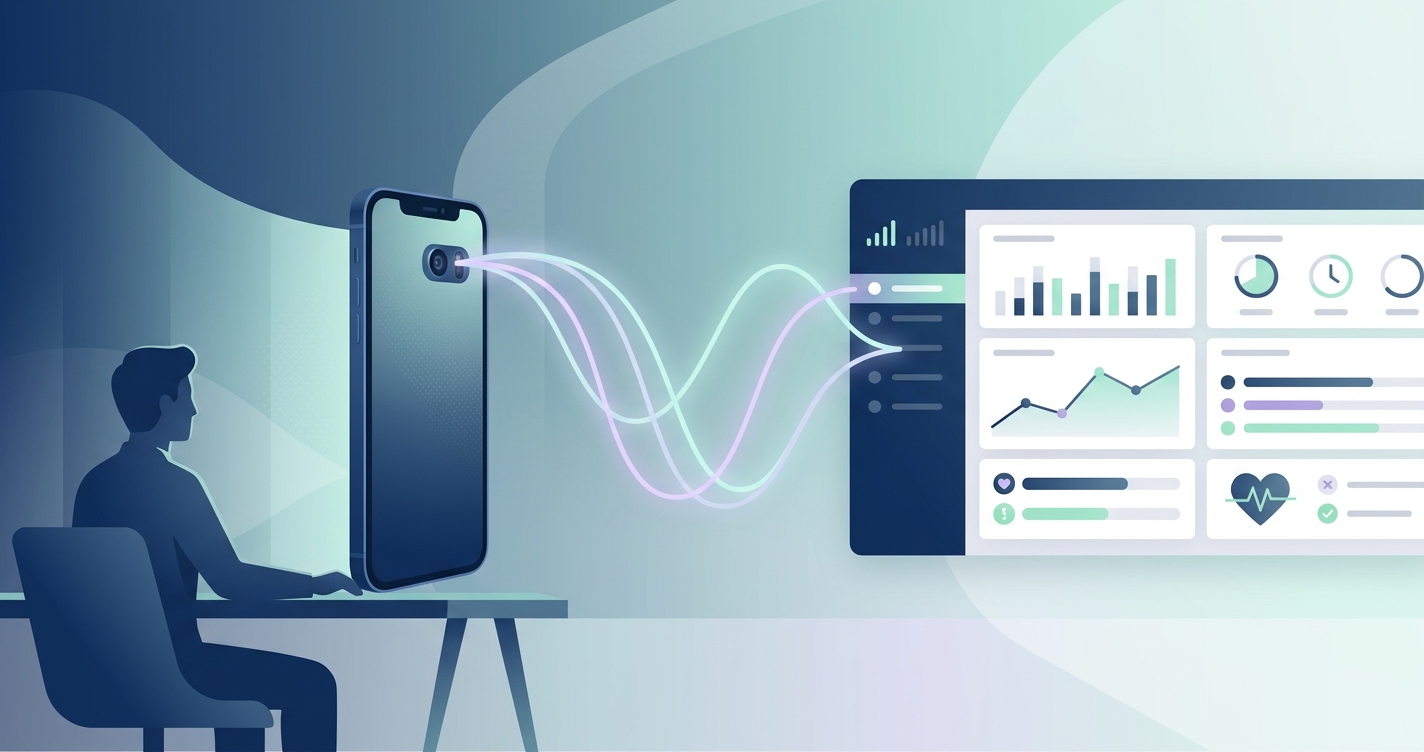
Most remote patient monitoring programs stall on the same problem: hardware. A diabetes or hypertension cohort signs up, then the clinical team has to procure, configure, ship, and support a connected cuff or pulse oximeter for every enrolled patient. Devices get lost, batteries die, and Bluetooth pairing generates a support ticket queue that no one budgeted for. Building remote patient monitoring contactless vitals into your existing app sidesteps that entire supply chain. Instead of mailing a box, you turn the camera the patient already carries into the measurement device, and the readings flow straight into your monitoring dashboard. For product and engineering leads at health platforms, that shift changes the unit economics of an RPM line of business.
The global remote patient monitoring market is projected to reach roughly $63.75 billion in 2026, growing at a 15.4% CAGR from $55.24 billion in 2025, with the global RPM patient base on track to hit 580 million people., Research and Markets, Remote Patient Monitoring Market Report 2026
Why remote patient monitoring contactless vitals changes the build
Traditional RPM treats the measurement device as the center of gravity. Your roadmap fills up with firmware certification, device inventory, return logistics, and a help desk that mostly resets pairing codes. Camera-based vitals invert that model. Remote photoplethysmography (rPPG) reads the subtle color changes in facial skin caused by blood flow, so a 30-to-60 second selfie video produces heart rate, respiratory rate, heart rate variability, and increasingly blood pressure trend and oxygen saturation estimates. No box to ship, no inventory to track, and onboarding becomes a screen in your app rather than a fulfillment workflow.
For an engineering team, the integration surface is a health monitoring SDK for RPM plus an API to persist results. The patient opens your app, holds steady for under a minute, and the SDK returns structured vitals. Your backend handles thresholds, trending, and alerting exactly as it would for a connected cuff. The difference is that the capture layer is software, which means it versions, updates, and scales like the rest of your stack.
The reimbursement math is part of why this matters in 2026. New CPT codes 99445 and 99470 took effect January 1, 2026, broadening what RPM clinical time and shorter monitoring windows can bill. Existing codes 99453, 99454, 99457, and 99458 remain in use. The billable event is the data and the clinical review, not the specific sensor, which is what makes a contactless vitals API telehealth approach commercially viable rather than just convenient.
| Factor | Hardware-based RPM | Contactless vitals (rPPG SDK) |
|---|---|---|
| Per-patient device cost | $40 to $120 plus shipping | None, uses existing phone or webcam |
| Onboarding time | Days, gated by fulfillment | Minutes, in-app |
| Logistics overhead | Procurement, returns, replacements | None |
| Support burden | Pairing, batteries, firmware | Standard app support |
| Scalability | Linear with device inventory | Software-scalable |
| Measured signals | Single device, single metric | Multi-metric per session |
| Integration effort | Per-device firmware work | One SDK plus API |
The tradeoff is honest to state. Hardware cuffs and oximeters remain the reference for spot-accurate single readings under clinical conditions, and camera vitals depend on lighting, stillness, and skin tone handling. The practical pattern most teams land on is hybrid: contactless capture for broad, frequent at-home vital signs tracking and trend detection, with connected devices reserved for patients whose care plan needs cuff-grade confirmation.
How the integration actually works
Adding RPM with camera vitals breaks into a handful of well-defined components:
- A capture SDK embedded in your mobile or web client that runs the rPPG signal extraction on-device or streams frames securely.
- A results contract that returns each metric with a confidence or quality score, so weak readings can be flagged or retried.
- A persistence layer through a vitals signs API integration that writes time-stamped results to the patient record.
- A rules engine for thresholds, streak detection, and escalation to clinical staff.
- A consent and privacy flow, since camera capture triggers app store review scrutiny and health-data obligations.
The signal-quality score is the part teams underestimate. A reading taken in a dim room with the patient moving is not the same as one taken under steady light. Surfacing that score lets you discard or re-capture rather than feed noisy data into a clinical alert, which protects both the care team and the patient experience.
Industry applications
Chronic care management
Hypertension, heart failure, and COPD programs depend on frequent, low-friction check-ins. Published RPM outcomes show readmission reductions of 18 to 22% for heart failure cohorts and 20 to 25% fewer emergency visits for COPD patients. Frequency drives those gains, and a contactless capture that takes under a minute removes the adherence drop-off that comes with finding, charging, and pairing a device.
Telehealth and virtual-first clinics
A video visit already has the camera open. Embedding a health monitoring SDK for RPM lets the clinician capture vitals inside the same session, closing the data gap that makes virtual visits feel thinner than in-person ones. This is where a contactless vitals API telehealth integration earns its keep, because the measurement happens where the encounter already lives.
Payer and employer wellness
Large populations make hardware distribution prohibitive. Camera-based at-home vital signs tracking lets a payer or self-insured employer offer screening and longitudinal trending across hundreds of thousands of members without a logistics operation behind it.
Current research and evidence
A 2024 systematic review of non-contact vision-based vital sign monitoring published in MDPI Sensors confirmed that heart rate and respiratory rate measurement via rPPG are well established, with active research extending into blood pressure and oxygen saturation. The same body of work is candid about limits: accuracy degrades with ambient light variation, subject movement, darker skin tones, and elevated heart rates. A 2024 analysis reported in News-Medical found that rPPG accuracy drops sharply at high heart rates, which matters for any program enrolling cardiac or exercising patients.
Investment is tracking the science. The AI-powered remote vital sign camera market, driven largely by rPPG, reached USD 1.48 billion in 2024 according to Growth Market Reports, with strong projected growth through 2033. A 2024 Frontiers in Physiology review of rPPG for health assessment reinforced the multi-modal direction the field is moving: combining facial signal extraction with machine learning to push beyond single metrics toward stress, sleep, and hypertension-risk indicators.
The consistent message across this literature is that camera vitals are production-ready for trend monitoring and triage, and that responsible deployment means treating the per-reading quality score as a first-class signal rather than an afterthought.
The future of contactless RPM
Three shifts are worth planning for. First, multi-metric capture in a single session is consolidating, so one short scan increasingly returns heart rate, respiration, HRV, and blood pressure trend together rather than as separate flows. Second, reimbursement is widening, and the 2026 CPT additions suggest a regulatory direction that rewards more frequent, lower-friction monitoring, which favors software capture. Third, robustness across skin tone and lighting is the active research front, and the vendors that close that gap will define what clinical-grade contactless monitoring means.
For teams building now, the design choice is to keep the capture layer modular. Treat vitals capture as a swappable service behind your own RPM logic, so you can add metrics, raise quality thresholds, or run hybrid hardware-plus-camera flows without rebuilding your monitoring core.
Frequently asked questions
What hardware do patients need for contactless RPM?
None beyond a device they already own. Remote patient monitoring contactless vitals runs on the standard camera in a smartphone, tablet, or laptop. The patient holds steady for roughly 30 to 60 seconds and the rPPG SDK returns structured readings, which removes the procurement and shipping logistics that hardware RPM requires.
Is camera-based vitals capture accurate enough for RPM?
For heart rate and respiratory rate, peer-reviewed reviews from 2024 treat rPPG as well established. Accuracy varies with lighting, movement, skin tone, and very high heart rates, so the practical pattern is to use contactless capture for frequent trend monitoring and triage, with connected devices reserved for patients who need cuff-grade confirmation. Surfacing a per-reading quality score keeps noisy data out of clinical alerts.
How long does it take to integrate a contactless vitals SDK?
The capture layer is typically the fast part, often days to a working prototype with a drop-in SDK. The longer work is around it: persistence through a vitals signs API integration, threshold and escalation rules, consent flows, and app store review for camera health features. Scoping those alongside the SDK from day one prevents the prototype-to-production stall.
Can contactless RPM be reimbursed?
RPM reimbursement centers on the data captured and the clinical review time, not the specific sensor. The CPT framework, including the new 99445 and 99470 codes effective January 2026 alongside existing 99453, 99454, 99457, and 99458, governs billing. Confirm program-specific requirements with your billing and compliance teams, since device and data requirements differ by code.
Circadify is building developer tooling for exactly this shift, a drop-in rPPG SDK and contactless vitals API designed to add camera-based monitoring to an existing app in days rather than months. Product and engineering leads scoping an RPM line can grab developer docs and API keys, or book an RPM consultation, at circadify.com/custom-builds.