Can I really add heart-rate monitoring to my app in a weekend?
Can you add heart-rate monitoring to an app in a weekend? A research-based look at rPPG SDK integration scope, prototype timelines, and production tradeoffs.
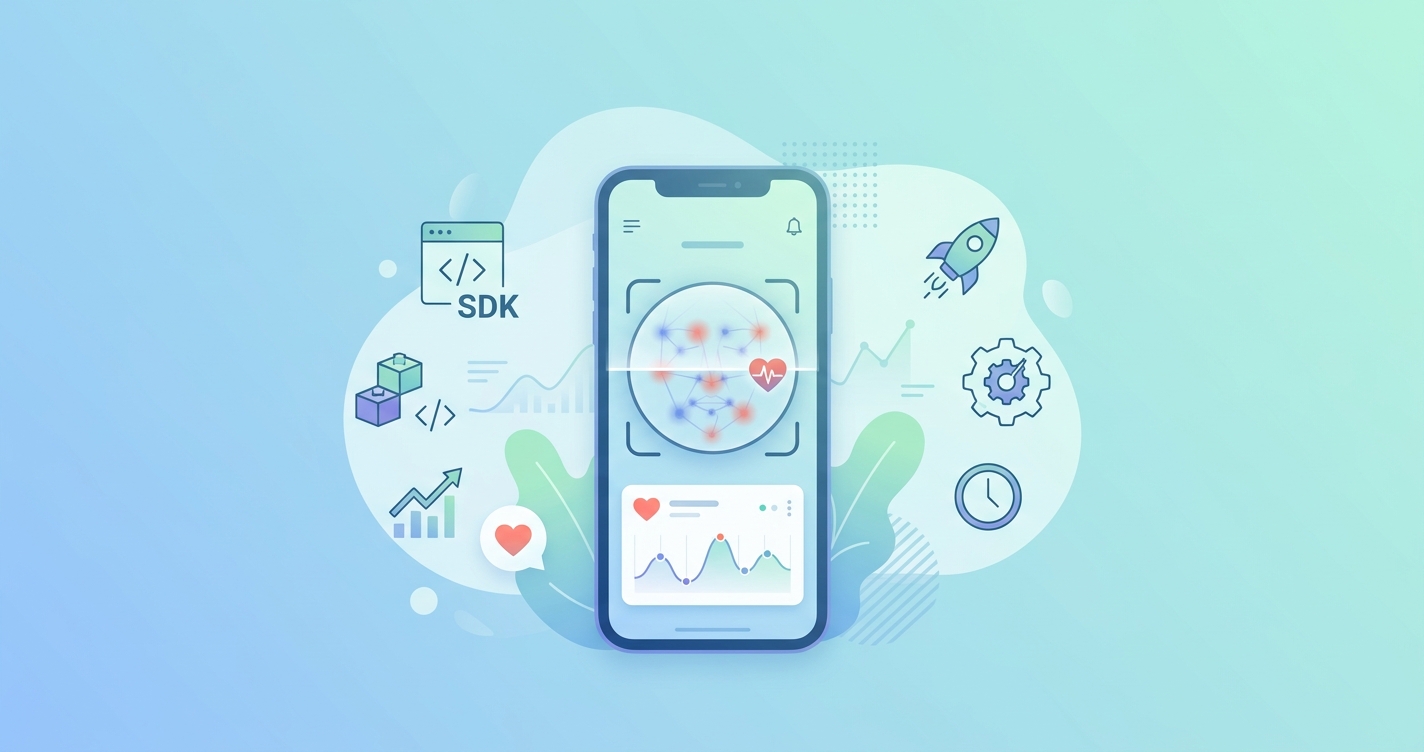
Can I really add heart-rate monitoring to my app in a weekend?
Yes — if by "add heart-rate monitoring" you mean getting a working prototype into an existing app, a weekend is realistic. If you mean shipping a production-ready feature with polished UX, analytics, device testing, privacy review, and store-submission hardening, the answer is usually no. That gap matters. A lot of teams asking whether they can add heart rate monitoring app weekend are really asking a narrower question: can we prove the feature works fast enough to justify a real build?
"Smartphone applications using photoplethysmography for heart rate monitoring show agreement with validated methods in adult populations during resting sinus rhythm." — Benjamin De Ridder, Bart Van Rompaey, Jarl K. Kampen, Steven Haine, and Tinne Dilles, JMIR mHealth and uHealth meta-analysis
Add heart rate monitoring app weekend: what is actually possible?
A weekend build is mostly about reducing moving parts. Daniel J. McDuff and colleagues from Microsoft, the Air Force Research Laboratory, and Ball Aerospace described remote optical photoplethysmography as a way to recover blood volume pulse from ordinary camera video in their 2015 survey of rPPG methods. That is the scientific basis behind modern camera-based heart-rate features. The engineering question is different: how much infrastructure do you need before that science becomes a usable app feature?
For most teams, the answer depends on three variables:
- Whether the camera flow already exists in the app
- Whether the team is comfortable using an SDK instead of building signal processing from scratch
- Whether the goal is a prototype, pilot, or production release
A developer can absolutely wire up camera access, start a scan session, and return a heart-rate estimate over a weekend if the SDK handles the signal-processing layer. What usually slips the timeline is everything around the measurement itself: retries, motion handling, loading states, bad-light guidance, QA across devices, and policy language for privacy and app review.
| Goal | Weekend feasibility | What you can usually finish | What usually remains |
|---|---|---|---|
| Proof of concept | High | Camera capture, SDK call, basic result screen | Error handling, UX polish |
| Internal demo | High | Branded flow, basic analytics, limited device testing | Edge cases, privacy review |
| Pilot launch | Medium | Narrow rollout, basic logging, support docs | Full QA, store-readiness work |
| Production launch | Low | Some teams can get close with existing camera infrastructure | Security review, cross-device testing, release hardening |
The important point is that "weekend" is not a fantasy number; it is just a prototype number.
Why prototypes move much faster than first-time teams expect
The fastest builds happen when the app already has a front-camera workflow. In that case, developers are not inventing a new capture experience. They are inserting a measurement layer into an existing interaction.
That matters because frame acquisition is one of the biggest sources of complexity. McDuff's survey made clear that rPPG quality depends on stable video input, consistent illumination, and controlled motion. Teams do not need to reproduce the underlying research over a weekend, but they do need to respect those constraints in the product design.
A small proof-of-concept usually includes:
- A front-camera permission prompt
- A guided capture window
- A short countdown or session timer
- A simple success or retry state
- An API or SDK response rendered in the UI
That is a manageable scope for an experienced mobile engineer. A first-time team trying to build face tracking, signal extraction, filtering, and result interpretation alone will not finish in a weekend. An SDK changes the timeline because it collapses years of computer-vision and signal-processing work into a few integration steps.
For developer teams evaluating feasibility, the real comparison is not "can we do this in two days?" It is "are we prototyping the workflow or re-creating the science stack?"
Industry applications that justify a rapid prototype
Consumer wellness apps
Consumer apps often use a weekend prototype to test engagement. Does a heart-rate check increase session length? Does it fit naturally into onboarding or a daily check-in? Those are product questions, not purely technical ones.
Telehealth and care-navigation products
Here the goal is usually workflow validation. Teams want to see whether a quick camera-based reading can sit beside intake, symptom review, or triage preparation without adding friction.
Insurance, benefits, and underwriting flows
In these environments, heart-rate monitoring is often less about a standalone feature and more about expanding a digital assessment flow. That is why rapid prototyping is valuable: it helps product and compliance teams evaluate fit before committing to a larger integration.
Current research and evidence
The literature supports the idea that smartphone-based heart-rate measurement can work well enough for serious product exploration. The De Ridder meta-analysis in JMIR mHealth and uHealth found that smartphone photoplethysmography apps showed agreement with validated methods in adults at rest. That does not mean every implementation is equal, but it does support the feasibility of the category.
A second useful reference is the Clinical Validation of Heart Rate Apps: Mixed-Methods Evaluation Study in JMIR. Thijs Vandenberk and coauthors concluded that the strongest validation approach is simultaneous measurement against ECG with beat-to-beat analysis. For product teams, that is a reminder that a weekend build can establish feature viability, but serious validation needs a more structured test plan.
McDuff's survey is still helpful because it explains why fast prototypes can be convincing while still being incomplete. rPPG works best when lighting, subject motion, and frame stability cooperate. That means a demo on one phone, in one office, on one founder's face is only the beginning. It answers "can this work?" but not yet "will this work reliably across our user base?"
Three research-backed constraints show up again and again:
- Motion can corrupt the pulse signal if the capture experience is too loose
- Lighting quality changes result consistency more than many product teams expect
- Validation standards matter if the feature is moving beyond internal experimentation
That is why the smartest weekend projects are narrow by design. They test one flow, one device set, and one user moment.
What turns a weekend build into a month-long project
The engineering lift grows quickly once teams move past feasibility.
| Layer | Prototype effort | Production effort |
|---|---|---|
| SDK integration | Hours to 1 day | 1-3 days with refactoring |
| Camera UX | Basic overlay and timer | Guided retakes, accessibility, localization |
| Reliability | Minimal | Lighting checks, motion feedback, retry logic |
| Data handling | Temporary logs | Privacy policy alignment, retention controls |
| QA | One or two devices | Broad device matrix and regression testing |
| Release prep | Internal build only | App review language, support docs, analytics |
This is where CTOs and VP Engineering teams often recalibrate. The prototype is not the expensive part. The expensive part is making the experience resilient enough that users trust it and support teams can explain it.
That does not weaken the case for fast prototyping. It strengthens it. If a team can learn in two days whether heart-rate monitoring improves activation, retention, or lead quality, that is an efficient use of engineering time.
The future of rapid health-feature prototyping
The broader direction is clear: camera-based measurement is becoming more modular, not less. Better SDK packaging, improved mobile compute, and more mature camera frameworks all favor faster experimentation. Product teams no longer need a full in-house computer-vision group to test whether a heart-rate feature belongs in their app.
What will probably change next is not the speed of the first prototype, but the speed of the second phase. Teams will expect prebuilt analytics hooks, device-specific tuning, and cleaner policy templates so that the jump from internal demo to real deployment is less painful.
That is especially relevant for developer platforms. The winner is rarely the system with the flashiest demo. It is usually the one that lets a team get to a credible first milestone quickly, then survive the messier work that follows.
Frequently asked questions
Can a solo developer add heart-rate monitoring to an app in a weekend?
Often, yes for a prototype. A solo developer using an SDK can usually get camera capture, a scan session, and a result screen working over a weekend. Production release work usually takes longer.
What is the biggest blocker to a fast heart-rate integration?
Usually not the core measurement call. The bigger blockers are camera UX, device testing, and handling bad scans caused by motion or lighting.
Is a weekend prototype enough to validate the feature?
It is enough to validate technical feasibility and get an early product signal. It is not enough for cross-device reliability claims or formal validation work.
Should teams build rPPG from scratch for a fast proof of concept?
Usually no. The fastest route is using an SDK and focusing internal engineering time on product fit, capture flow, and instrumentation.
If your team wants to see whether camera-based heart-rate monitoring belongs in your product, Circadify is building for exactly that kind of rapid evaluation and deployment path. You can explore a custom implementation approach at Circadify custom builds, and for more technical context, see How to Add Contactless Vitals to Your App and rPPG SDK iOS and Android Integration.